International B2B Touchpoints: How Companies Reach and Engage Buyers
International B2B buying decisions rarely depend on a single interaction. Reaching the right organisations means identifying where buyers discover solutions, compare providers and build confidence, both online and offline.
What counts as a touchpoint in international B2B?
A touchpoint is not necessarily an advertising channel. A purchasing manager may first encounter a manufacturer through a technical specification, an engineering consultant or an approved supplier list. Another buyer may find the same company through Google, an AI-assisted search, a specialist publication or a trade show. Later, an audit, a client reference or a technical meeting may determine whether the supplier stays on the shortlist.
Our article on international B2B buying patterns explains why this cannot be reduced to one digital customer journey. A touchpoint matters when it supports an identifiable buyer’s research or decision process.
What the evidence tells us
The McKinsey Global B2B Pulse Survey 2026, based on nearly 4,000 decision-makers across 13 countries, reports that buyers use an average of ten channels along the purchasing journey. These include face-to-face, remote and digital self-service contacts. The figure is a survey average, not a recommendation to operate ten marketing channels. AI-enabled search, chatbots and large language models now rank among buyers’ top five channels during the purchase journey. [1]
The 2025 Edelman–LinkedIn B2B Thought Leadership study also highlights the influence of less visible stakeholders, including procurement, finance and compliance. Specialist content may affect people who never attend a sales meeting and who are not the eventual product users. [2]
Neither study provides a universal list of winning channels. Both reinforce the need to examine the roles in each buying committee and the interaction between digital and human contact.
Different buyer roles need different evidence
| Buyer role | Typical question | Possible touchpoints |
|---|---|---|
| Engineering and users | Will the solution work in our application? | Technical portals, data sheets, case references, expert calls |
| Procurement | Does this company meet the technical and commercial requirements? | Industry directories, tenders, audits, quotation meetings |
| Management | Does the investment fit strategic objectives? | Industry reports, referrals, business cases, personal networks |
| Operations, quality and compliance | Can implementation and ongoing operation be trusted? | Certifications, test reports, service plans, customer conversations |
These are possible patterns, not fixed allocations of responsibility. The actual participants and veto holders vary by product, sector and market. Buyer research is how those assumptions are tested.
Which touchpoints matter at each stage of the purchase?
| Stage | Information need | Likely contact |
|---|---|---|
| Defining the problem | What technical or financial alternatives exist? | Industry articles, search, AI research, peer networks |
| Identifying companies and solutions | Who can supply this application? | Search results, manufacturer listings, events, referrals |
| Evaluating options | Which solution meets performance and delivery requirements? | Data sheets, comparisons, references, engineering discussions |
| Approving a purchase | What are the cost, risk and contract implications? | Supplier audits, procurement dialogue, compliance records, partners |
These stages overlap and decisions can return to earlier questions. International B2B SEO and AI visibility support discovery and evaluation of information. They do not replace qualification, procurement procedures or personal discussions.
Why touchpoints change from one market to another
Even within one industry, the route to a purchase can vary between countries. Distributor and integrator networks, public procurement rules, technical standards, trade associations and the sources buyers trust may all shape the process. Language and search terms are just two elements of that wider picture.
Before entering a market, companies should verify whether the same industry directories, search questions and buying practices apply there. Local search results, market evidence, company information and direct conversations can reveal which assumptions are sound and which need to change.
Our existing article on B2B touchpoints involving South America explores a regional application. The approach here is broader: it is equally relevant to sales within Europe, into North America or between other international markets.
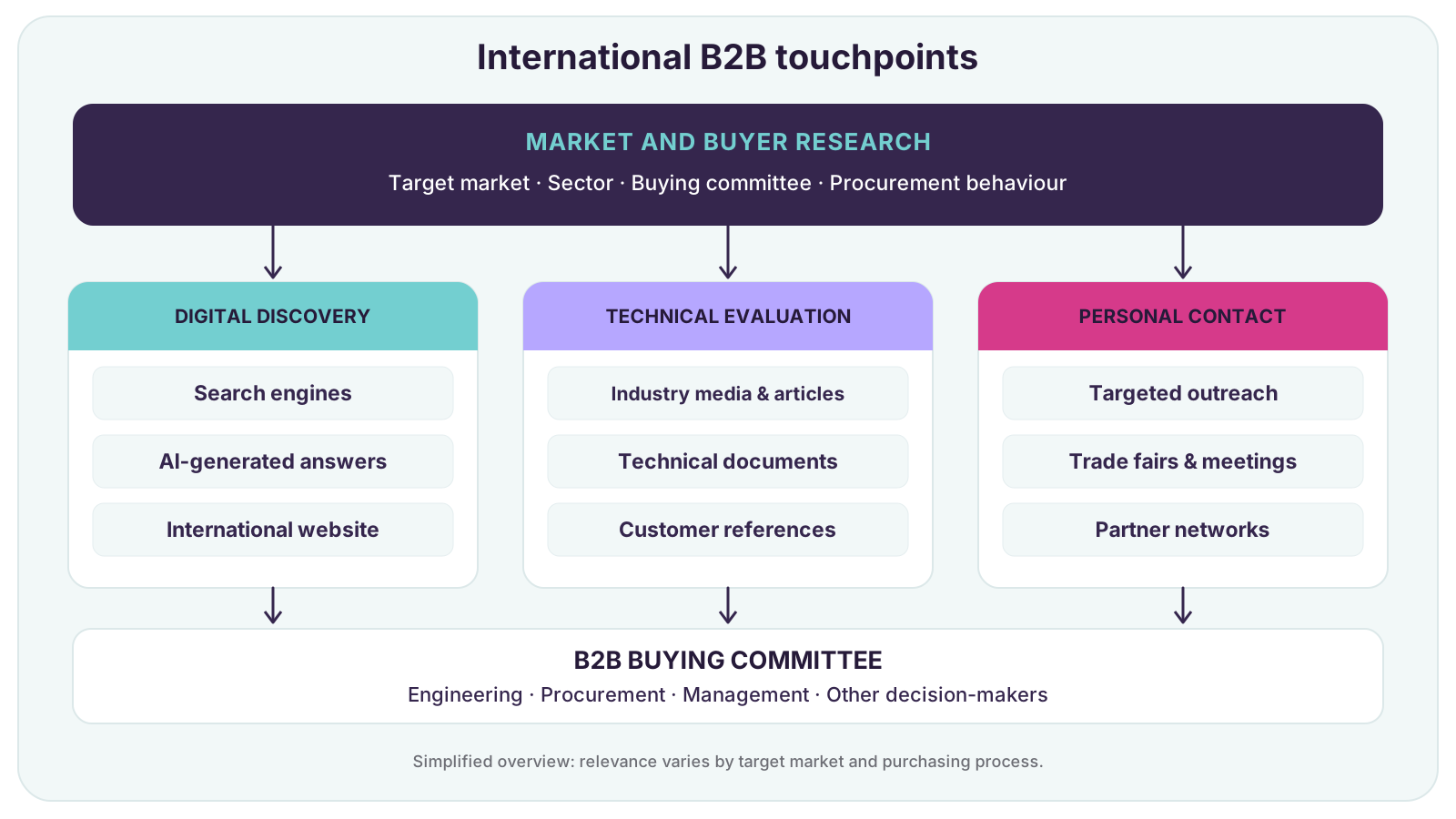
Understand markets and buyers → improve visibility at relevant touchpoints → establish credibility → develop qualified business contacts.
For South American research, VolzMarketing can additionally draw on the independently published market and company analysis at Econosur. This is an added regional research capability, not a geographic limit on the service.
Search rankings are of little value if they reach the wrong accounts. A technically correct article can still miss an influential buyer role, while direct outreach without market evidence can waste resources. international B2B market strategy evaluates target markets, companies, competitors, buying roles and real procurement routes. B2B touchpoint analysis turns that evidence into priorities.
4. The foundation: market and buyer research
Face-to-face meetings. Trade events, company visits and buyer meetings remain relevant to complex procurement. Complementary business delegation preparation is described as linguistic, intercultural and content-based preparation for specific business discussions, rather than a general language course.
Targeted outreach. Specialist industrial buyers may not actively search for every type of solution. international B2B lead generation combines target-account research, identification of decision-makers and planning for tailored outreach. Direct approaches can be carried out where separately agreed. An account on a list is not yet a qualified opportunity.
3. Direct contact: turning visibility into conversations
Sales and product documents. Datasheets, presentations, catalogues and proposals circulate inside the buying committee long after the first meeting. B2B document localisation adapts those materials linguistically and commercially for the target market, with consistent terminology and clear technical claims.
Specialist articles and thought leadership. Technical content, application examples and market analysis can answer questions raised by engineers, procurement teams and internal reviewers. B2B Content & Thought Leadership develops relevant information for distinct buyer roles and purchasing stages, including use in trade publications and industry portals.
2. Technical evaluation: providing credible evidence
The international company website. Buyers need clear product information, references and reliable ways to contact the company in their market. The International Website Review assesses site structure, language variants, search terms and contact routes, and provides a prioritised action plan. Implementation is agreed separately.
AI answers and AI-assisted research. Purchasing teams increasingly use ChatGPT, Perplexity and other AI tools to identify potential providers and compare technical options. B2B AI visibility examines whether a provider is included in relevant answers, how its offer is represented and where verifiable information is missing.
Search engines in the target market. Through international B2B SEO, VolzMarketing examines local search behaviour, application-specific queries, competing providers and existing visibility. This evidence guides content, website structure and technical SEO priorities.
1. Digital visibility: where buyers discover companies
International touchpoint research connects VolzMarketing’s existing services. The starting point is to identify suitable target accounts, understand how they evaluate potential business partners, and establish where those buyers can actually be reached. This research informs targeted improvements to existing channels rather than an indiscriminate expansion of marketing activity.
Which B2B touchpoints can VolzMarketing develop or improve?
Illustrative example: Industrial filtration in two markets
Hypothetical scenario: A Dutch industrial filtration manufacturer wants to reach plant engineering companies in France and Canada. Running the same campaign in both markets only makes sense if the target organisations, buying arrangements and research channels are sufficiently similar.
The manufacturer first identifies relevant engineering contractors, operators and technical planners. It then checks each market separately for industry directories, specialist events, search behaviour and procurement systems. Conversations with prospective buyers validate or challenge those assumptions. Only after this research does it decide where to publish technical material and which contacts deserve direct sales follow-up.
Nothing in this example demonstrates whether search, referrals or industry media will be more influential in either country. That is the question to investigate, not a conclusion to assume.
Prioritise touchpoints instead of spreading effort everywhere
Each channel can be assessed against five practical questions: Does it reach the buyer role we need? Is there evidence that those buyers use it? Can we contribute credible information? Is the expected value proportionate to the cost? Can the commercial team capture feedback?
- Define the market and target accounts: Specify applications, buyer segments and purchasing triggers.
- Map the buying group: Identify users, technical decision-makers, procurement and internal reviewers.
- Verify contact routes: Compare search results, sector sources, company lists and direct feedback.
- Close priority gaps: Improve technical explanations, suitable content or targeted outreach.
- Validate through sales: Record relevant conversations, objections and concrete next steps.
This is the logic behind the VolzMarketing method: market and buyer understanding first, then visibility and qualified contacts. Our B2B touchpoint analysis applies this reasoning to a specific commercial question.
How to measure meaningful progress
Digital indicators include relevant search visibility, qualified visits to technical pages and enquiries from fitting organisations. Offline signals include meetings arranged through partners, requests for documentation, invitations to discuss specifications and acceptance into supplier qualification processes. A count of mentions or impressions alone does not establish commercial value.
| Area | Possible indicators |
|---|---|
| Search | Relevant queries, qualified visits, international visibility |
| AI discovery | Mentions and cited sources for defined buyer questions |
| Website | Enquiries, use of technical material, suitable account interactions |
| Specialist content | Relevant reach, third-party citations, qualified feedback |
| Direct outreach | Responses, meetings arranged, qualified contacts |
| Personal meetings | Follow-up discussions, technical reviews, quotation requests |
An AI mention or a website visit is not yet a lead. A qualified opportunity requires evidence of account fit, a plausible need and an agreed next step. See our guide to generating B2B leads.
Conclusion: International B2B visibility develops where real buyers research, compare and decide. Evidence-led touchpoint priorities help connect digital discovery, expert information and personal sales activity without treating every country or buyer role as identical.
Conclusion: International B2B visibility starts with the buyer
Search engines, AI systems, trade publications, recommendations and business meetings all create possible contact points. Their value depends on real buying behavior. Market research identifies relevant paths; visibility and specialist content help companies become findable and credible; direct contact supports commercial discussions.
Related services and further insights
- B2B touchpoint analysis
- International B2B market strategy
- Buyer research
- International B2B SEO
- AI visibility
- Service: B2B lead generation
- Insight: How to generate B2B leads
- AI visibility and international B2B sales
- Qualifying international B2B leads
- B2B touchpoints in South America

Sources and interpretation
19 October 2026
These studies describe general patterns, not uniform behaviour in every market. The business example is hypothetical.
Which touchpoints reach your international B2B buyers?
VolzMarketing examines target markets, buying roles and information sources, then prioritises work on visibility, credible technical content and qualified business contacts.
Three practical starting points
- International Market Review: Assess a market, suitable segments and routes to buyers.
- B2B Target Account Research: Identify relevant target accounts and professional contacts.
- International Website Review: Review international website visibility, structure and contact routes.