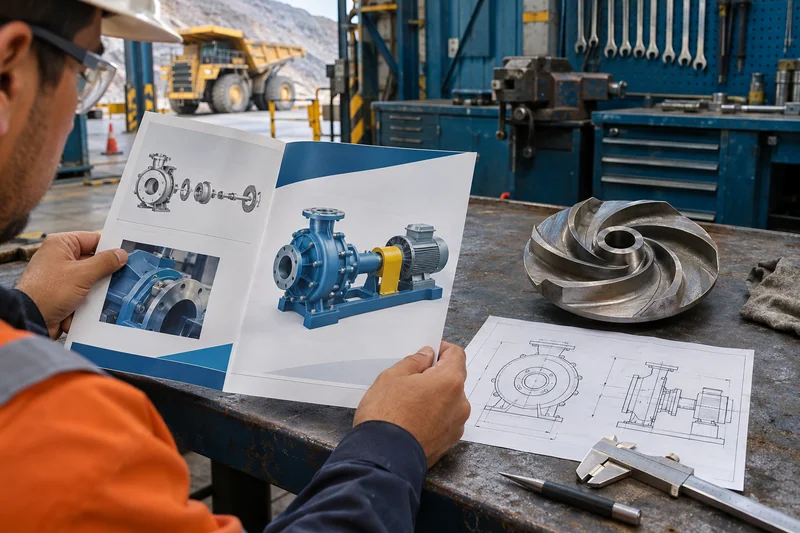
What a buyer wants from your brochure
A company sends a 30-slide presentation to a mine. The maintenance engineer has one question: will the pump fit the existing line, and can it go in during the next planned outage? The answer is spread across three attachments. The supplier may know the equipment well. It just expects the reader to assemble the answer from information intended for different purposes. That is where our sales materials for mining suppliers start.
The question in a sales meeting is usually more specific than anything in a product catalogue. A site wants to know where the equipment goes and whether it can perform a task. Procurement will need to know what it receives and what the price covers. VolzMarketing prepares material to answer those questions from information the company already has. The work can begin with one product for one conversation. It does not have to become a redesign of the company's entire range of sales material.
A technical brochure that people can forward to a colleague
Take a pump that returns water from a concentrator to the production process. Fine particles can remain in that water. If the existing pump wears out quickly, a drawing of the proposed replacement is more useful when the reader knows the duty for which it was designed. The pump curve shows how the flow changes at different pressures. Material and connection dimensions give the plant a way to assess where the pump would fit and how it would be installed.
The technical brochure should describe the application, the performance that can be documented and a drawing or photograph that helps explain it. A reference can show where a pump replaced an earlier model and what the operator observed afterwards. If a figure came from a trial, state how the trial was conducted. If it applies to one medium or load, specify that condition. A buyer can do more with a result that can be compared with the site's own figures than with a promise that the pump is reliable.
What the presentation and conversation guide add
A sales presentation is used in a meeting. It can start at the point where the customer is having trouble, then explain what would change in the plant, what evidence the supplier has and what needs further discussion. One slide on a pump replacement could show the installation and dimensions. Another could show what the operator has to do during the outage and which work the supplier takes on. The presenter then has a clear reason to ask about the next step.
The conversation guide is for the sales team. It collects the questions to ask before making an offer. Does the existing pipe have to stay? What happens if delivery is delayed? Are wear parts stocked in the country? The right response may be to check a point with engineering and call back. We can collect these questions from your technical and sales teams and write the answers in a form that can be used when someone calls from a site or sends a follow-up email.
What the handover to sales can look like
Suppose the salesperson has a first call with an operator in Chile. The data sheet gives the flow at which the proposed pump was designed to work. A workshop report shows when parts on an earlier pump were replaced and under what conditions. We can put those facts on one page with the equipment location and the information still needed from the plant, such as the water composition and time available for installation.
When a follow-up arrives, sales and engineering can answer from the same record. The conversation guide can distinguish questions the salesperson can answer straight away and claims engineering needs to check. The later presentation can preserve the source of the figures, incorporate what the customer told the team and show what is still open. That makes the material useful to the next person who joins the discussion.
How VolzMarketing works on the material
We begin with the reason the company needs it. Is a new plant being designed, are you proposing a replacement to an existing customer or are you preparing for a trade event? We then review what already exists. It might include a data sheet, a maintenance report or a commissioning record. If we cannot support a clear statement with the information available, we ask your team. Text, drawings and numbers are prepared for the application you want to sell. Technical approval remains with you.
For Chile or Argentina, we can write in Spanish and adapt contact details and descriptions of local support. If you already have material, send a data sheet and tell us who will use it. We can discuss whether a brochure would solve the immediate problem or whether a presentation and a conversation guide would help your sales team as well.