
Entitymap · International B2B · AI Visibility · June 2026
Entitymap in International B2B: Making Services, Markets and Buyer Logic Machine-Readable
Why international B2B companies should not only publish services, applications, markets, buyer questions and sources — but structure them as a coherent meaning layer that search and AI systems can interpret.
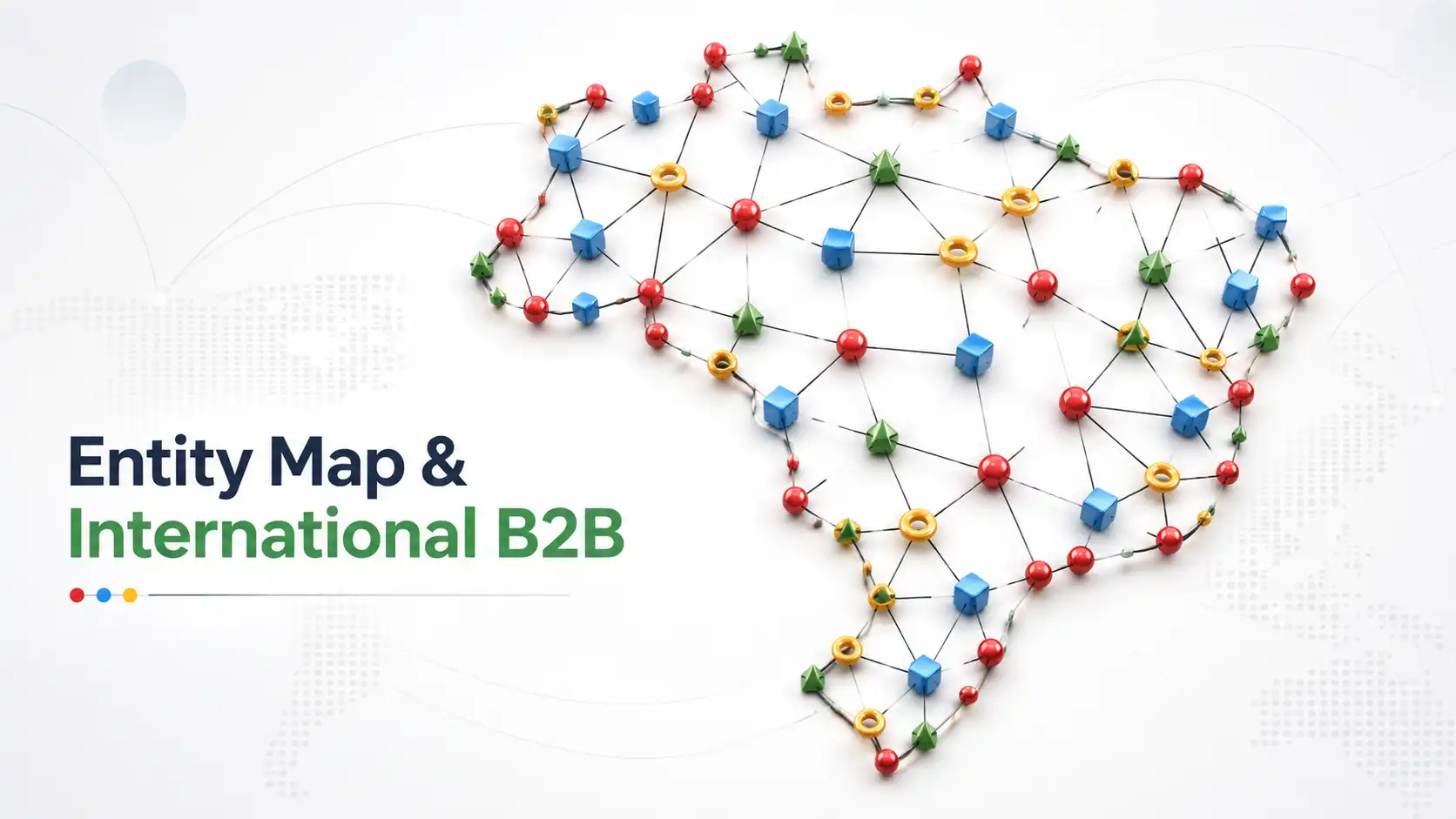
In international B2B, an Entitymap is not a new sitemap and not a replacement for Schema markup. It is an additional meaning and evidence layer: it describes which entities a company covers, how these entities relate to each other and which sources support key claims.
For international B2B companies, this matters because they are not understood only through products or services. They are interpreted through markets, industries, applications, buyer problems, local terms, service capability, references, partner structures and source environments.
Core thesis: International B2B visibility is a structure problem
Many B2B websites explain what a company offers. For a human reader, that can be enough. For search engines, AI systems and retrieval models, it often remains unclear how the individual pieces of information belong together.
A machinery manufacturer can have a product page, a Brazil page, a service page and technical documents. Each page can be correct in isolation. Digital interpretation can still remain weak if it is not clear which machine is relevant for which application, which industry, which buyer problem and which target market.
This is where Entitymap becomes relevant as a concept. A sitemap shows which URLs exist. Schema markup describes structured information on individual pages. An Entitymap aims to structure the meaning layer across the website: companies, services, products, people, markets, topics, relations and evidence.
Where this fits into the VolzMarketing architecture
This insight complements VolzMarketing topics such as Market & Search Intelligence, international SEO consulting, AI Search Visibility Analysis, international B2B visibility and Brand Marketing in the Knowledge Graph.
For the market case, the most relevant internal pages are Brazil as a digital market, Brazil in Mercosur market entry and machinery and industrial equipment in Mercosur.
How an Entitymap differs from a sitemap, Schema and an About page
The difference is not the file extension. It is the layer being organized. A sitemap organizes URLs. Schema markup helps describe certain information on individual pages. An About page explains the brand from the company’s own perspective. An Entitymap tries to make the relationships between the relevant knowledge elements of a website explicit and machine-readable.
| Layer | What it does | Limit in international B2B |
|---|---|---|
| Sitemap | It shows crawlers which URLs exist and can be indexed. | It does not explain what those pages mean for markets, services or buyer questions. |
| Schema markup | It gives search engines structured signals about individual pages, organizations, articles or products. | It describes page elements, but not necessarily the full service, market and relationship logic. |
| About page | It explains a company’s origin, profile and self-description. | It often remains too general and rarely reflects the operational B2B service logic across markets. |
| Entitymap | It connects entities, relations and evidence into a machine-readable meaning structure. | It is only solid if the visible content, internal links and sources actually support that structure. |
Source note · As of June 3, 2026
- EntityMap Specification v1.0 — technical specification for entitymap.json and entitymap.html
- Search Engine Journal: EntityMap as an open standard — public consultation until June 30, 2026, planned launch on July 1, 2026
- Google Search Central: AI Features and your website
- Google Search Central: Optimizing for generative AI features
- Google Search Central: Introduction to structured data markup
- Waikay.io: Entitymap Case Study — self-published case study, treated here as an early signal
- ABIMAQ: Setor de máquinas e equipamentos — desempenho 2025 e perspectivas 2026
- ABIMAQ: Machinery and equipment loses momentum in April 2026
Why international B2B companies are especially vulnerable to misinterpretation
International B2B companies rarely have a simple visibility problem. They have a multi-layered meaning problem. A company can be a manufacturer, exporter, technical problem-solver, industry partner, service provider, market actor and part of a distribution structure at the same time.
These roles do not automatically appear clearly in search engines and AI systems. A company can be clearly visible as a manufacturer in its home market, but in the target market it may appear mainly through distributors, importers, trade fair profiles, PDF catalogues or industry directories. The brand may be mentioned, but not necessarily interpreted correctly.
That is why international B2B visibility cannot be solved by translating a website or optimizing isolated service pages. The decisive question is whether the business logic behind the offer becomes recognizable: who offers what, for whom, in which market, for which problem and with which evidence?
Strategic reading: why an About page is usually not enough
An About page explains who a company is. An international B2B Entitymap would also need to show which services, products, markets, applications, buyer problems, sources and evidence belong together. That connection is often more important than the general company description.
The Waikay case: early signal, not independent evidence
The Waikay case does not prove a new standard, but it is a useful early signal: structured entity data can become more visible than classic corporate pages in certain AI retrieval situations. Waikay installed an Entitymap on April 25, 2026 and then examined how AI systems responded to brand-related questions.
According to the self-published case study, some AI Visibility Scores improved significantly, including a 26-point increase in a hallucination-related topic within 48 hours. The entitymap.html page was also cited more often in Gemini and Sonar than the company’s own About page. These numbers should be read with caution: they come from a vendor-published case study and have not been independently verified.
The project gains additional technical weight because R.V. Guha, one of the founders of schema.org, reviewed and supported the specification according to Search Engine Journal. That does not replace broad market validation, but it places EntityMap more clearly within the structured data environment.
| What the case suggests | What it does not prove | Reasonable B2B conclusion |
|---|---|---|
| Structured entity data can be picked up and cited by certain AI systems. | That Entitymap is already an established standard for all search and AI systems. | Entitymap is a relevant test field for AI visibility, but not a replacement for content, indexing and source work. |
| An entitymap.html page can become a citable source for brand queries. | That every website will automatically improve its visibility. | The quality of the underlying company, service and source structure remains decisive. |
| Live retrieval systems can pick up certain changes relatively quickly. | That Bing, ChatGPT, Copilot or Claude signals will automatically follow the same pattern. | Indexing, internal linking, sitemap inclusion and crawlable HTML structure remain mandatory. |
Case example: a machinery company targeting Brazil
Brazil works well as a case because machinery is not only a product topic there, but also a market structure topic. A European machinery manufacturer that wants to sell into Brazil does not only need to be visible as a manufacturer. It also needs to be understood in the right industry, application, service and procurement contexts.
The current sector situation shows why this matters. ABIMAQ reported net revenue of R$ 298.9 billion for the Brazilian machinery and equipment sector in 2025, with growth of 7.3%. In 2026, the environment became more difficult: in April 2026, ABIMAQ reported a 14.9% decline in net sales revenue compared with April 2025 and pointed to a weaker investment environment, higher interest-rate pressure and import pressure.
For an international B2B company, this means the market is not simply “large” or “attractive”. It is segmented, cyclical, financing-dependent, locally shaped and strongly influenced by industry logic. That market logic needs to become visible in a B2B Entitymap.
Example starting point
A European manufacturer of packaging machines, conveyor systems or industrial equipment wants to become more visible in Brazil. The website explains machines, technical features and global experience. But Google, Gemini, Perplexity or other systems do not clearly recognize for which Brazilian industries, applications, buyer questions and service requirements the company is relevant.
| Entity layer | Example in the machinery case | Why it matters for Brazil |
|---|---|---|
| Company | European manufacturer of machinery or industrial equipment | The company needs to be recognized as a manufacturer, not merely as a supplier, distributor or generic brand. |
| Product / machine | Packaging machine, conveyor system, process machine, automation solution | The machine needs to be connected with concrete applications and industries, not only with general product terms. |
| Application | Food processing, agro-processing, packaging, mining, chemicals | Brazilian search and buyer logic often emerges through application, sector and problem — not through the manufacturer name. |
| Buyer problem | Production downtime, local maintenance, spare parts, certification, import capability | B2B buyers do not only ask “which machine?” They ask “who reduces my operational risk in this market?” |
| Market | Brazil, Mercosur, Latin America, regional industrial clusters | The target market has to appear as its own context, not as a generic international destination. |
| Source / evidence | Market page, case study, service page, technical documentation, partner reference | AI systems need citable evidence so they do not reconstruct the relationship from external sources or old fragments. |
What an Entitymap would need to represent in the machinery case
An Entitymap for this case should not simply list product names. It would need to represent the company’s commercial and service logic in a structured way.
A machinery company does not sell only a machine in Brazil. It sells production reliability, technical compatibility, service capability, spare-parts availability, industry understanding, import logic and confidence in a supplier that understands the target market.
Who is the manufacturer, what role does it play internationally and which markets does it actually serve?
Which machines, systems, components or technical solutions are relevant for the target market?
For which applications are the machines used: production, packaging, processing, automation, maintenance or modernization?
Which industries are involved: agribusiness, food, chemicals, healthcare, mining, energy, automotive or infrastructure?
Which risks or decisions drive demand: downtime, local maintenance, spare parts, compliance or financing?
Which pages, documents, cases or sources support these claims in a visible and crawlable way?
An Entitymap for international B2B companies does not only connect pages. It makes the market and buyer logic behind services machine-readable.
Why Brazil works especially well as a case
Brazil shows the international B2B visibility problem very clearly: it is a large, industrially relevant market and at the same time not self-explanatory from the outside. In machinery and technical B2B services, several layers come together: language, import logic, local sector structure, distributors, financing, service expectations and regional demand.
A manufacturer can be technically strong and still appear digitally weak if its role in the Brazilian market is not represented clearly. Search systems may recognize product terms, but not the relationship between machine, application, target industry, Brazilian buyer problem and credible evidence.
The result is a typical international B2B weakness: the company is found for its own name, but not for the market questions that buyers, partners, importers, integrators or technical decision-makers actually ask.
Practical question: why not simply optimize for industrial machines Brazil?
Because international B2B visibility rarely emerges from a generic keyword. Buyers search by application, industry, problem, technical solution, spare parts, maintenance, local providers, import capability or concrete specifications. An Entitymap helps represent these layers as connected, not isolated.
| Weak visibility | Stronger Entitymap logic | Consequence for AI Search |
|---|---|---|
| The website mentions machines, but no clear applications. | Machines are connected with applications, industries and buyer problems. | AI systems can better recognize what the offer is relevant for. |
| Brazil appears only as a country in a list of markets. | Brazil is connected with language, market logic, sector structure, service questions and sources. | The market reference becomes operationally understandable, not decorative. |
| Distributors and intermediaries dominate the results. | The manufacturer is built as its own entity with clear service and source logic. | The brand is less likely to disappear behind intermediary actors. |
| Product pages are technically strong, but commercially isolated. | Products are linked to decision questions, use cases and evidence. | The content becomes more citable for complex B2B questions. |
| Sources are scattered: PDF, catalogue, trade fair profile, LinkedIn, old news. | Important evidence is integrated into a structured logic. | AI retrieval has to reconstruct less from scattered fragments. |
What an Entitymap cannot do — and what needs to come first
An Entitymap cannot repair weak positioning. It also cannot replace evidence that does not exist. If a company cannot clearly state for which markets, industries, applications and buyer problems it is relevant, an Entitymap only makes that lack of clarity machine-readable.
That is the key difference between technical implementation and strategic work. An entitymap.json or entitymap.html is only the structured output. The real work comes before that: understanding market logic, analyzing search spaces, identifying buyer questions, organizing content, connecting sources and defining the company’s role across languages.
Strategic reading: Entitymap does not replace SEO
Google frames AEO and GEO in its AI Search guidance as “still SEO”. For structured data, Google also states that no special Schema.org markup and no special AI file are required to appear in generative search features. Entitymap should therefore be understood as an additional meaning and evidence layer, not as a guaranteed visibility mechanism.
How VolzMarketing would structure an Entitymap review
For VolzMarketing, Entitymap work does not start with a file. It starts with a review of market, service and source logic. Only when the relevant entities are clear does it make sense to make them machine-readable.
The first step is therefore a claim and entity inventory: What claims does the company make about itself? Which services does it claim to provide? Which markets does it name? Which industries does it want to serve? Which buyer problems does it promise to solve? And which of these claims are actually supported by evidence?
| Review layer | Guiding question | Typical finding |
|---|---|---|
| Entity Recognition | Is the company clearly recognized as a manufacturer, provider or advisory unit? | The brand appears, but its market role remains vague. |
| Service Logic | Are services, applications and buyer problems clearly connected? | Services are named, but not translated into decision situations. |
| Market Context | Is the target market built as a meaning space of its own? | Brazil or Latin America appear only as a country or region name, not as market logic. |
| Language Fit | Do English, Spanish, Portuguese and German terms fit the target market? | Translations may be correct, but the search and buyer logic remains too generic. |
| Evidence Layer | Which sources support claims about market, service, industries and expertise? | Evidence exists, but it is not connected with concrete claims. |
| AI Citation Fit | Can AI systems extract short, clear and supported statements from the website? | The content is solid, but too scattered or not easily citable on its own. |
Related questions covered by this analysis
This page covers central follow-up questions: what an Entitymap is, how it differs from a sitemap and Schema, why it matters for international B2B companies, how it can be applied to machinery, Brazil and complex buyer logic, what role AI Search, Google AI Overviews, Gemini, Perplexity, sources, internal links and market structure play, and what the Waikay case and Guha endorsement do — and do not — prove.
Internal pages for implementation and review
FAQ: Entitymap in international B2B
What is an Entitymap?
An Entitymap is a structured, entity-first file that describes which entities a website covers, how those entities relate to each other and which sources support the main claims.
Is an Entitymap the same as a sitemap?
No. A sitemap shows which URLs exist. An Entitymap describes what a website knows, which entities it covers, how they are connected and where the supporting evidence can be found.
Does an Entitymap replace Schema markup?
No. Schema describes structured information on individual pages. An Entitymap adds a site-wide meaning layer through entities, relations and sources.
Why is it relevant for international B2B companies?
Because an international B2B company needs to be understood through services, markets, applications, industries, buyer problems, sources and languages. These relationships are often scattered across classic websites.
Why does Brazil work as an example?
Brazil is a large and complex industrial market with its own language, local sector structures, service expectations, importers, distributors and specific commercial logic.
Can an Entitymap guarantee AI visibility?
No. An Entitymap does not guarantee visibility. It can help provide company, service and source logic in a more structured way, but only if the content, indexing, internal links and evidence are already solid.
Conclusion: Entitymap makes B2B meaning testable
An Entitymap becomes interesting for international B2B companies when it is not treated as a technical trick, but as a structured translation of market, service and buyer logic.
For machinery, industrial equipment and other complex B2B offers, this means services cannot remain isolated. They need to be connected with markets, applications, industries, buyer problems, service questions and sources.
When that structure is missing, search and AI systems interpret the company from fragments. When it exists, the chance increases that the company is not only found, but also understood correctly.
Review international B2B visibility and entity structure
VolzMarketing helps companies review international B2B visibility, Market & Search Intelligence, AI visibility and machine-readable meaning structures — especially for complex services, multilingual websites and target markets in Europe, North America and Latin America.
ContactVolzMarketing is a specialized consultancy for Market & Search Intelligence, international B2B visibility and digital market analysis. The focus is on how companies are understood in search engines, AI systems, source environments and international markets: not only through rankings, but through market logic, entities, evidence and clear strategic interpretation.
volzmarketing.com