
Brand Marketing · Knowledge Graph · B2B Visibility
Brand Marketing in the Knowledge Graph: How Companies Build Digital Meaning
Why B2B brands in North America and Europe need more than visibility: they need consistent entity signals, market context, source alignment and machine-readable meaning across search and AI systems.
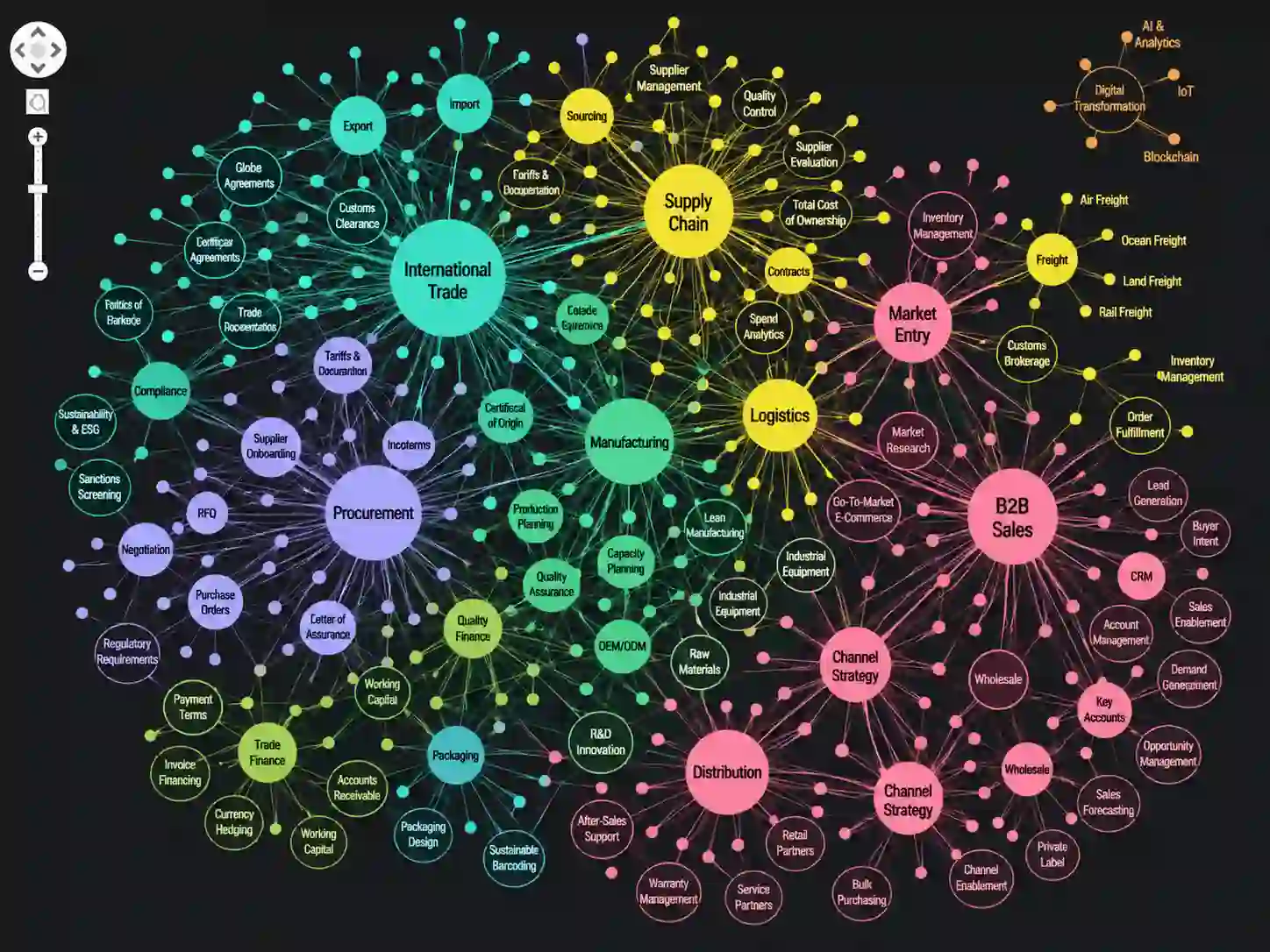
Brand marketing in the Knowledge Graph means that a company is not only recognized through its logo, messaging or campaigns, but through the consistent digital connection of organization, people, services, markets, languages, sources and topics.
For B2B companies operating between North America and Europe, this becomes strategically important. Search engines and AI systems do not only read isolated webpages. They try to understand companies as entities: who is behind the brand, what the company stands for, which markets it is relevant in, which sources confirm that role, and whether this meaning remains consistent across English, French, German, Spanish and other market-specific contexts.
The core thesis: a brand is not only recognition, but machine-readable meaning
B2B brands will increasingly be judged not only by whether people recognize them, but by whether search engines and AI systems can clearly interpret them. Traditional brand marketing focuses on perception, trust, design, tone and repetition. Those elements remain important, but they are no longer sufficient on their own.
In search and answer systems, brand strength also emerges from semantic clarity. A company should not only claim to be “international”, “innovative” or “trusted”. It needs to show, through concrete and verifiable signals, in which markets, topics, industries and decision contexts it is relevant.
The strategic question is therefore not only: “Is the brand known?” It is: “Is the brand recognizable as the right entity for a specific market, buyer or expert question?”
Where this fits within VolzMarketing
This insight connects with VolzMarketing’s work on Market & Search Intelligence, international SEO consulting, AI search visibility analysis, brand visibility and AI Market Signal Audits.
Two related VolzMarketing analyses are especially relevant: the Trolli Paradox and AI visibility, and the Argentina Leak and AI market interpretation. Both show how AI systems may classify companies, markets or source environments differently from how business audiences expect them to be understood.
What the Knowledge Graph has to do with brand marketing
The Knowledge Graph is not a classic marketing channel. It is an interpretation layer. It connects entities such as companies, people, places, industries, products, sources, organizations and topics. For brands, this means visibility is not created only through content, but through relationships between signals.
A B2B brand becomes easier to interpret when its name, services, markets, authors, company profiles, external mentions and structured data produce a coherent picture.
That is the difference between communication and digital meaning. Communication sends messages. Digital meaning emerges when those messages can be interpreted by search systems, Knowledge Graphs and AI answers as part of a coherent entity.
Source note for methodological context · Last reviewed: 26 May 2026
This analysis is based on official Google documentation on structured data, Organization markup, the Knowledge Graph Search API and guidance for generative search features. The sources were reviewed on 26 May 2026.
Side question: Is brand marketing in the Knowledge Graph the same as Schema markup?
No. Schema markup is only a technical signal. Brand marketing in the Knowledge Graph includes visible content, internal site architecture, external sources, author context, company profiles, recurring terminology, market relevance and consistent entity data. Structured data only helps when the visible content supports the same meaning.
Why B2B brands often fail to build enough digital meaning
Many B2B companies communicate their brand visibly, but not interpretably enough. They may have a clear claim, strong design, product pages and references. Still, the brand remains ambiguous for search engines and AI systems.
The issue is often not a lack of quality, but a lack of semantic connection. The website explains services, but not the market. The LinkedIn profile uses different terms than the website. The author or expert role is weak. External validation is missing. Regional or language pages repeat content without building market-specific meaning.
For human readers, this can still look understandable. For search engines and AI systems, it may produce a weak or inconsistent brand picture.
| Weak brand signal | Stronger meaning signal | Implication for B2B marketing |
|---|---|---|
| Generic claim without context | Clear connection to markets, industries, services and buyer questions | The brand becomes not only memorable, but also interpretable. |
| Single service page | Connected system of service, insight, market and proof pages | Search systems recognize a topic environment, not only an offer page. |
| Translated content | Language- and market-specific meaning spaces | English, French, German and Spanish can reflect different source and buyer logics. |
| Unclear author or company role | Consistent person, organization and service connection | The brand becomes easier to interpret as a responsible expert entity. |
| No external validation | Sources, profiles, expert content, directories and observable market signals | The brand claim becomes more verifiable and more citation-ready. |
In international B2B search results, this problem often becomes visible when a company is commercially present in a market but digitally represented mainly by distributors, resellers, partner pages or generic directories. For European companies expanding into North America, or North American firms entering European markets, this can create a distorted brand picture: the market presence exists, but search engines and AI systems may not recognize the original company as the primary relevant entity.
There is not one single Knowledge Graph for an international brand
A brand can be understood differently across languages and regions. This is one of the most important issues in international B2B marketing. English, French, German and Spanish are not only translation layers. They create different search environments, source environments and comparison frames.
A company may appear highly credible in the United States, but much less clearly positioned in Canada. It may be well understood in English-speaking markets, but poorly connected to French-language sources in Québec or France. It may be visible in Germany, but not sufficiently associated with the right European industry terminology, trade context or buyer questions.
International brand management in the Knowledge Graph is therefore not just consistency. It is controlled meaning work across markets and languages.
Side question: Why can different languages create different brand pictures?
Because each language activates different sources, media, industry terms, competitors, search intents and buyer expectations. A brand is not understood everywhere from the same documents, SERPs and source relationships. International B2B brands need to check whether they occupy the same role, a weaker role or a distorted role in each relevant language environment.
| Market / language context | Typical risk | Brand marketing check |
|---|---|---|
| United States | The brand competes with a dense ecosystem of established providers, media sources, directories and review signals. | Is the company specific enough to be understood beyond generic B2B or international SEO language? |
| Canada | The brand may be visible in English but weak in French-language contexts, especially around Québec-related searches and sources. | Is the brand interpretable across both English and French market environments? |
| United Kingdom | The brand may be interpreted through local sector terminology, procurement language and UK-specific industry sources. | Does the company build a distinct UK-relevant meaning space instead of relying only on global English content? |
| Germany | The brand may look technically credible but insufficiently linked to international buyer questions and English-language discovery. | Is the German entity clearly connected to international markets, services and decision contexts? |
| France | French-language source environments can create a separate interpretation layer from English-facing international content. | Does the brand show meaning in French, not only translated messaging? |
| Spain | Spanish-language visibility can be blurred if Spain, Latin America and global Spanish search contexts are not separated. | Is the brand clearly positioned for Spain, Latin America or both, without mixing different market logics? |
Relevant digital market contexts
These VolzMarketing market pages support the separation of regional search behavior, language environments and source ecosystems.
Which signals build digital meaning
Digital meaning emerges when several signals support the same brand role. A single page is rarely enough. What matters is the interaction between the company website, internal linking, external sources, company profiles, author context, structured data and recurring terminology.
Company, brand, author, services, markets and topics must be clearly named and connected.
Terms such as Market & Search Intelligence, AI search visibility, international SEO consulting and brand visibility should appear consistently.
International brands need more than translation. They need recognizable meaning spaces for regions, countries and languages.
Sources, profiles, expert articles, directories and mentions help support the brand role outside the company website.
Article, WebPage, Organization, Person, BreadcrumbList and FAQPage markup can support the visible content structure technically.
Short, self-contained passages help search engines and AI systems extract and interpret individual statements correctly.
Digital meaning does not emerge from a single signal, but from consistently connected entities.
Why this matters for AI visibility
AI systems do not generate answers from keywords alone. They use available sources, search signals, entity relationships and answer contexts. That is why brand marketing in the Knowledge Graph becomes a foundation for AI visibility.
If a company is not clearly represented as a relevant entity, it can be missing from AI answers, described incorrectly or displaced by competitors, resellers, media sources or generic industry portals.
Google continues to connect generative search features closely to core search requirements such as crawling, indexing, helpful content and clear site structure. For companies, this means that AI visibility does not start with a new trick. It starts with better structure, better context and better evidence.
GEO_Fanout_Coverage of this analysis
This page addresses key follow-up questions: What does brand marketing in the Knowledge Graph mean? What role do entities play? Why do language environments differ? How do B2B companies build digital meaning? Which signals help Google and AI systems interpret a company? Why is Schema not enough? How are brand visibility, Search Intelligence and AI Visibility connected?
Brand marketing becomes work on meaning spaces
The practical task is to build meaning spaces: for the brand, the market, the language, the service and the decision context. A company should not only communicate what it offers. It should show in which system its offer is relevant.
For international B2B companies, this means: a brand must be evidenced differently in the United States than in Canada, differently in the United Kingdom than in Germany, differently in France than in Spain. Not because the brand becomes arbitrary, but because sources, search terms, buyer questions and competitors work differently in each market.
Brand marketing in the Knowledge Graph is therefore not a departure from brand. It is a deeper layer of brand work: brand as an interpretable system.
| Layer | Guiding question | Meaning for the digital brand |
|---|---|---|
| Brand | What does the company clearly stand for? | The core positioning must be recognizable and semantically consistent. |
| Service | Which decision or task does the offer support? | Services should be connected to decision situations, not only described. |
| Market | In which country, region or industry is the brand relevant? | Market context prevents international positioning from becoming too generic. |
| Language | Which terms, sources and search patterns shape the language environment? | Language environments create different brand pictures and Knowledge Graph contexts. |
| Source | Which internal and external sources support the brand role? | Evidence increases trust, citation readiness and interpretive stability. |
| Person | Who is responsible for the analysis or advisory work? | Author and expert context strengthen E-E-A-T and entity clarity. |
Relevant service pages
For implementation, these VolzMarketing pages are especially relevant:
Common mistakes in brand marketing for the Knowledge Graph
The most common mistakes occur when brand marketing is treated as surface communication rather than meaning architecture. The brand may look professional, but remain difficult for search engines and AI systems to interpret.
- The brand uses strong claims, but lacks clear market and service context.
- The website describes services, but not buyer questions or decision situations.
- Language versions are translated, but not semantically localized.
- Author, organization and service data are not consistently connected.
- External profiles, LinkedIn, the website and structured data do not tell the same story.
- Sources, proof points, case references or observable market signals are missing.
- The brand is interpreted differently or inconsistently across countries.
Side question: Can a strong brand still be weak in the Knowledge Graph?
Yes. A brand can be known to people and still appear digitally ambiguous. This often happens when external sources are missing, language environments are not developed properly, services are described too generically or search engines cannot clearly connect entities, markets and topics.
What companies should check
Companies should check whether their brand is understood by search engines and AI systems as a clear, accurate and relevant entity. This assessment should not only look at the company name, but also at generic market, service and buyer questions.
| Assessment layer | Guiding question | Typical finding |
|---|---|---|
| Entity Recognition | Is the company recognized as a distinct entity? | The brand appears mainly through its own pages, but weakly through external sources. |
| Representation Accuracy | Is the company described correctly? | AI systems confuse service, market, target audience or provider role. |
| Language Consistency | Does the brand picture remain coherent across English, French, German and Spanish? | Each language creates a different or weaker interpretation. |
| Source Layer | Which sources confirm the brand role? | Independent, expert or market-relevant proof is missing. |
| Search Context | For which generic questions does the brand appear? | The company ranks for its name, but not for relevant decision contexts. |
| AI Citation Fit | Are passages structured so they can function as an answer or source? | Content exists, but is too long, vague or not self-contained enough. |
VolzMarketing evaluates these points not through a single keyword or prompt query, but through the comparison of local SERPs, AI answers, source environments, language context, competitive landscape and visible entity structure. This makes it possible to see whether a brand is merely mentioned — or whether it appears as a relevant, correctly described and evidence-backed B2B entity.
FAQ: Brand Marketing in the Knowledge Graph
What does brand marketing in the Knowledge Graph mean?
Brand marketing in the Knowledge Graph means building a brand not only as communication, but as a consistent digital entity. This includes the company, people, services, markets, languages, sources, topics and structured data.
Is brand marketing in the Knowledge Graph the same as Schema markup?
No. Schema markup is only one technical signal. The decisive elements are visible content, internal architecture, external sources, author context, company profiles, recurring terminology, market relevance and consistent entity data.
Why can different languages create different brand pictures?
Because every language activates different sources, media, industry terms, competitors, search intents and buyer expectations. International B2B brands need to check whether they occupy the same role or a distorted role in each relevant language environment.
Why is this important for AI visibility?
AI systems use available sources, search signals, entity relationships and answer contexts. If a company is not clearly represented as a relevant entity, it can be missing from AI answers, described incorrectly or replaced by competitors and generic sources.
Can a strong brand still be weak in the Knowledge Graph?
Yes. A brand can be well known to people and still appear digitally ambiguous if external sources are missing, language environments are weak, services are described too generically or search engines cannot clearly connect the relevant entities, markets and topics.
The practical consequence for B2B companies
B2B companies should no longer treat brand marketing, SEO, GEO, content structure and market intelligence as separate disciplines. Digital brand strength emerges where people, search engines and AI systems can recognize the same role.
This does not require artificial AI language. It requires clear terminology, real evidence, market logic, consistent profiles, clean internal linking and content that answers concrete buyer questions.
The strongest B2B brands will not only be searched. They will be understood as relevant entities.
Assess brand visibility and AI visibility
VolzMarketing helps companies assess digital brand visibility, search logic, AI visibility and market relevance — especially in international B2B contexts, multilingual websites and complex target markets in North America and Europe.
Contact VolzMarketing