
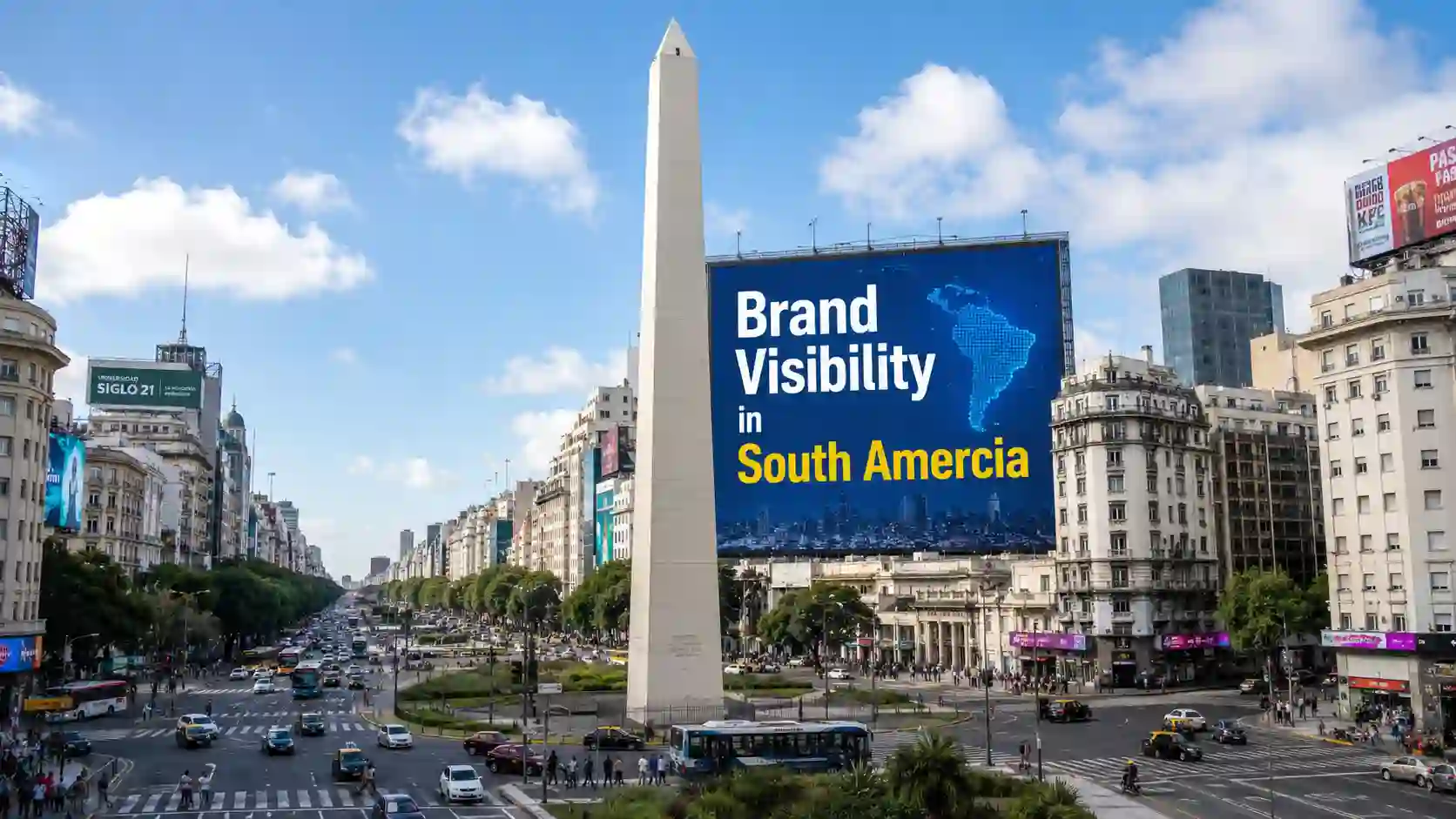
Brand Visibility in South America: A Brand Becomes Visible Country by Country
A website can be accessible throughout South America without the brand being genuinely visible in Brazil, Argentina or Chile. What matters is whether buyers, search engines and AI systems can associate the brand with a specific country, language, offer and credible sources.
Core idea
- South America is digitally accessible, but it is not one visibility market.
- Website availability is not the same as brand visibility.
- Visibility combines discoverability, interpretation and corroboration.
- Language and query formulation influence which sources AI systems retrieve.
- Regional visibility is the sum of strong country-level positions.
Brand visibility in South America is not built through a single regional landing page. A brand becomes visible when it can be found for relevant searches in a specific country, when search engines and AI systems interpret it correctly and when credible sources confirm its relevance. Brazil, Argentina, Chile and Colombia therefore require separate decisions about language, content, searches, sources and market evidence.
A page can be accessible from every country and still remain absent from relevant searches, buyer questions and AI answers.
Languages, search terms, sources, institutions and evidence differ across South American markets.
Specialist media, associations, partners and projects complement the information controlled by the company.
South America is a large digital space, but not a single market
According to World Bank country data, approximately 435.3 million people lived in the twelve sovereign states of South America in 2024. Internet use ranged from around 77% in Venezuela and Ecuador to 96% in Chile. It stood at 84% in Brazil, 90% in Argentina and 92% in Uruguay. Source: World Bank, 2024 country data .
Digital access is broadly established throughout the region. The visibility problem is not caused by a lack of connected users.
The problem is classification. A brand can be technically accessible throughout South America and still not be perceived as a relevant supplier in any individual market.
“A brand can be accessible throughout South America without being precisely visible in a single South American market.”
The strategic question is therefore not merely whether a website is available in the region. The question is whether a Brazilian, Argentine or Chilean buyer finds the brand during a specific research process and correctly understands its offer.
Brand visibility combines three different levels
Brand visibility is often confused with reach. For international B2B markets, that interpretation is too superficial.
A brand is not visible merely because its website is indexed, it has a LinkedIn profile or some publications generate impressions.
Discoverability
Does the brand appear when a buyer searches for a problem, application, solution, product or supplier?
This includes search results, specialist portals, industry directories and sources opened during the research process.
Interpretation
Do Google, ChatGPT, Perplexity, Gemini or Copilot understand what the company offers, who it serves and which countries it can actually support?
A brand can be found and still be described too generally, inaccurately, out of date or associated with the wrong market.
Corroboration
Can buyers and information systems find external evidence of experience, projects, market presence and technical competence?
This is where specialist media, associations, partners, events, project documentation and credible mentions matter.
Visibility comes from the combination
Rankings without evidence may convert poorly. Mentions without clear service pages are difficult to interpret. Reach without search relevance does not necessarily reach the right buyer.
The working formula
Discoverability + correct interpretation + independent corroboration = robust brand visibility.
When one of these levels is missing, the visible brand image remains incomplete.
The relevant visibility market is the country first
Google distinguishes between multilingual websites and websites
aimed at specific countries. Its regional targeting signals include
dedicated URLs, hreflang, local language and currency,
addresses, telephone numbers and links from other local websites.
Source: Google Search Central
.
The search engine is not only trying to identify the language of a page. It is also trying to understand which market the page is meant for.
This distinction is fundamental in South America. Brazil requires Brazilian Portuguese content and its own search and source strategy. A Spanish-language Latin America page does not replace a Brazilian market presence.
Spanish-speaking countries do not form one homogeneous search market either. Terms, industries, institutions, media, directories and buyer questions differ between Argentina, Chile, Colombia, Peru, Paraguay and Uruguay.
| Market | Basic decision | Visibility signals to examine |
|---|---|---|
| Brazil | Brazilian Portuguese and a dedicated market and search strategy. | Brazilian search terms, specialist sources, market evidence, service coverage and clearly identified PT-BR pages. |
| Argentina | Content should reflect Argentine search and business language. | National terminology, concrete services, relevant references and identifiable responsible contacts. |
| Chile | Market and industry priorities should not be copied from other Spanish-speaking countries. | Specialist sources, industry evidence, projects, service capability and suitable search queries. |
| Colombia | Demand, competitors, sources and buyer questions should be examined separately. | Search results, media, associations, partners, evidence and country-specific service pages. |
| Other countries | Create dedicated pages only when there are genuine differences in market, language or offer. | Demand, competition, responsible contacts, operational capability, sources and content maintenance. |
Platforms and digital visitor flows are also country-specific
The ECLAC Marketplace Explorer records 2,938 digital commerce platforms in Latin America and the Caribbean. It also presents domestic and cross-border visitor flows by country.
The data covers platforms for the sale of goods to end consumers. It is therefore not a direct measurement of B2B brand visibility. Source: ECLAC Marketplace Explorer .
It nevertheless demonstrates an important structural point: international and regional platforms operate through country-specific domains, pages, offers and user flows. Digital reach is not distributed evenly across an abstract regional market.
Another ECLAC study examines more than 2,600 online service websites in Argentina, Brazil, Chile, Colombia, Mexico and Peru. Source: ECLAC, online services .
For a B2B brand, this does not mean it must be present on every marketplace. It means the relevant digital environment should be analyzed separately for each priority country.
That environment may include search engines, specialist media, industry associations, business directories, events, partners, procurement platforms and specialist economic sources.
AI search visibility increases the importance of independent sources
Generative systems do not merely display an ordered list of links. They select sources, connect information and produce their own answers.
An experimental 2025 preprint by Mahe Chen, Xiaoxuan Wang, Kaiwen Chen and Nick Koudas compared conventional Google results with several AI search systems across different topics, languages and query variants.
In the research setting, AI systems drew more frequently on editorial and other independent sources than on brand-owned content or social media posts. The systems also differed in source diversity, freshness, cross-language stability and sensitivity to query wording. Source: Chen et al., 2025 preprint .
This does not mean that the corporate website becomes unimportant. It remains the principal controllable source for explaining services, markets, people, projects and evidence.
The company's own website, however, is not always sufficient to independently corroborate the association between a brand and a market.
Corporate website
Explains services, markets, industries, locations, responsible contacts, processes, projects and evidence.
Media and associations
Confirm industry classification, market presence, professional relevance or participation in projects.
Partners and projects
Show with whom, where and in what context the brand actually works.
Registers and documentation
Can confirm company data, authorizations, memberships, procurement activity or participation in projects.
Language influences which sources an AI system retrieves
The assumption that AI systems automatically overcome every language boundary is too optimistic.
The ACL 2026 paper “All Languages Matter” shows that current multilingual RAG systems systematically favor English and the query language during reranking. Relevant information may exist in several languages without being treated equally. Source: Wang et al., ACL 2026 .
Another ACL 2026 study shows that semantically equivalent questions formulated in different languages can produce materially different retrieval results. Source: Huo et al., Findings of ACL 2026 .
These papers analyze general model behavior rather than specific South American markets. The mechanism is nevertheless relevant to international visibility.
The practical consequence for South America
- A large volume of English-language sources does not guarantee equivalent visibility in Portuguese-language queries.
- An English press release about a project in Chile does not automatically become a strong Spanish-language source.
- A general Spanish-language Latin America page may be less relevant than a precise market page for an Argentine query.
- Localization affects both the reader and the sources that systems can retrieve and weight.
This is why an international SEO strategy is not merely a technical issue. It must connect language, country, search intent, content and external sources.
Likewise, an international content strategy should not be limited to publishing identical translations for several markets.
The decisive factor is the local source footprint
In each priority country, a brand needs a robust digital source footprint. It does not need to be extensive, but it must be clear, verifiable and professionally relevant.
Unambiguous market page
1It explains what the company offers in the country, which buyers it serves and how cooperation, delivery or support works.
Localized search content
2It uses the terms buyers in the market use when searching for problems, applications, products and suppliers.
Concrete evidence
3Projects, references, responsible people, certifications, partners, locations or operational conditions reduce uncertainty.
Independent sources
4Specialist media, associations, partners, organizers and other credible sources corroborate the market and industry association.
Technical clarity
5URLs, internal links, structured data, language signals and regional signals help assign content to the correct market.
Only the combination of these elements produces a robust brand image. The quality and clarity of relevant sources are more important than the absolute number of mentions.
GEO is not a collection of technical tricks
The original scientific GEO paper showed that certain content modifications can increase the visibility of already retrieved information within generated answers. The effect varied by topic. Source: Aggarwal et al., GEO .
This does not guarantee that adding FAQs, sources or structured data will automatically make a brand appear in organic AI answers.
For brand visibility in South America, the strategic foundation is more important:
GEO requires a clear market foundation
- The brand clearly identifies the countries in which it operates.
- It explains in the appropriate language which problems it solves.
- Services, industries, locations and responsible people are described consistently.
- Market relevance is corroborated through professionally relevant sources.
- Structured data accurately reflects the visible content.
Structured data, direct answers and a clear architecture facilitate machine processing. They cannot replace a market presence that does not exist or evidence that is not available.
A robust visibility strategy is built country by country
A regional brand is not created by continuously expanding a generic South America page.
It is created by answering the same set of questions consistently for every priority market.
| Area | Question to answer | Possible measure |
|---|---|---|
| Market | In which country and for which buyers should the brand be visible? | Prioritize countries, industries and buyer groups. |
| Search | Which problems, applications, products and suppliers are buyers searching for? | Analyze queries, competitors and visible page types. |
| Language | Which language and national variant does the buyer use? | Localize content and develop consistent terminology. |
| Website | Which market, service, industry and evidence pages are missing? | Implement structure, internal links, metadata and schema. |
| Sources | Which external sources corroborate market relevance? | Develop media, association, partner, project and other source relationships. |
| Measurement | How is the brand represented in search and AI answers? | Review rankings, sources, mentions, descriptions and inquiries. |
Prioritize countries
1Not every market is addressed at the same time. Priority goes to markets with genuine demand, operational capability and strategic relevance.
Analyze searches and sources
2Search queries, competitors, specialist sources, directories and current AI answers are reviewed.
Build market pages and evidence
3The brand explains its offer, buyers, market, service capability and evidence through a clear structure.
Develop external corroboration
4Relevant sources are treated as part of the verifiable brand image, not merely as reach channels.
Measure and improve by country
5Visibility, answers, sources, competitors and inquiries are evaluated separately by market and language.
Common errors in regional brand visibility
One page attempts to cover all of South America
The brand remains too general because it does not address one country, language or group of buyer questions precisely enough.
Spanish is confused with regional localization
A linguistically correct text can still use inappropriate terms, examples and evidence for Argentina, Chile or Colombia.
Brazil is included within a Spanish-language strategy
Portuguese-language searches, Brazilian sources and PT-BR content cannot be replaced by Spanish-language pages.
FAQs and schema are expected to replace authority
Technical optimization can facilitate processing, but it cannot replace market evidence or independent sources.
International mentions are assumed to be locally equivalent
An English-language mention in the home market may not be used in the same way for a Spanish- or Portuguese-language query.
The whole region is analyzed as one channel
Without separating country, language, page, query and source, it is impossible to determine where visibility is actually being built.
How VolzMarketing analyzes brand visibility in South America
The analysis does not begin with a generic regional campaign. It first determines how the brand is found and interpreted in the priority countries.
Define markets and buyer questions
1Which countries, services, industries and questions are economically relevant to the brand?
Review search, AI answers and competitors
2Visible pages, cited sources, brand descriptions and competitor recommendations are compared.
Improve the website and source footprint
3Market pages, evidence, internal links, metadata, structured data and external sources are prioritized.
Implement the improvements
4The work can range from analysis and content architecture to direct implementation in WordPress.
Measure repeatedly
5Brand visibility is not assessed only once. Search results, AI answers, sources and competitors change continuously.
VolzMarketing Insight
Market reality: South America is not one visibility market. A brand first becomes visible in Brazil, Argentina, Chile or another specific country.
Search and AI visibility: language, query wording, page structure and available sources influence how a brand is found and interpreted.
Human interpretation: reach does not prove market position. What matters is whether buyers associate the brand with a concrete offer, market and body of evidence.
Sources and methodological basis
- World Bank: population and internet-use data for the twelve sovereign South American states in 2024. Open data
-
Google Search Central: multilingual and
multi-regional websites,
hreflang, language, currency, addresses and other regional signals. Open documentation - ECLAC Marketplace Explorer: 2,938 platforms and national and cross-border visitor flows in B2C commerce. Open Explorer
- ECLAC: database of more than 2,600 online service websites in six Latin American countries. Open study
- Chen, Wang, Chen and Koudas: comparison of AI search and conventional web search by topic, language and query variant; 2025 preprint. Open preprint
- Wang et al.: language bias during reranking in multilingual RAG systems, ACL 2026. Open paper
- Huo et al.: different retrieval results for semantically equivalent questions in different languages, Findings of ACL 2026. Open paper
- Aggarwal et al.: original research on Generative Engine Optimization and context-dependent visibility optimization. Open paper
Conclusion: Regional visibility is built through country-level positions
Companies often speak about increasing brand visibility “in South America.” Operationally, that wording is too imprecise.
The better question is which services the brand should be visible for in Brazil, which buyer questions it should answer in Chile, which sources corroborate its expertise in Argentina and whether it needs a dedicated market page in Colombia.
A brand is not visible in South America merely because it has a Spanish-language website, publishes content or maintains a regional landing page.
It becomes visible when buyers and information systems can associate it with concrete services, industries, sources and evidence in the relevant markets.
Core statement
Regional presence is availability. Brand visibility emerges from country-specific classification.
Frequently asked questions
What does brand visibility in South America mean?
It means that a brand can be found, correctly classified and corroborated through credible sources in a specific South American country. A website accessible throughout the region is not sufficient.
Why is a general South America page not sufficient?
Brazil, Argentina, Chile, Colombia and other countries differ in language, searches, specialist sources, institutions, market structures and buyer questions.
What role do local sources play in AI search visibility?
Specialist media, associations, partners, project pages and other independent sources can confirm that a brand is relevant in a specific country or industry.
Does every South American country require its own website?
No. Country- or language-specific pages make sense when demand, the offer, language, evidence, responsible contacts or market conditions genuinely differ.
What is the difference between SEO and GEO?
SEO improves the ability to appear in search engines. GEO improves the clarity and potential use of information in generative systems. Both require clearly defined content, markets and sources.
How can brand visibility in South America be analyzed?
The analysis reviews search results, AI answers, competitors, local sources, country and language pages, mentions, evidence and the way the company is classified in each market.

Marcus A. Volz combines international SEO, AI search visibility, market analysis and practical website implementation. He has lived in Argentina since 2006 and works with VolzMarketing and Econosur on international and South American markets.
His work includes search and competitor analysis, country-specific page structures, content, internal linking, structured data and WordPress implementation.
How visible and understandable is your brand in South America?
I analyze how your company appears in priority countries, on Google, in AI answers, against competitors and within relevant sources, and identify which pages, content and evidence are missing.
Analyze brand visibility