
Granular Optimization for AI Visibility in International B2B
Why companies are not visible in AI systems in a general way, but through specific markets, languages, industries, buyer questions, source environments and comparison contexts.
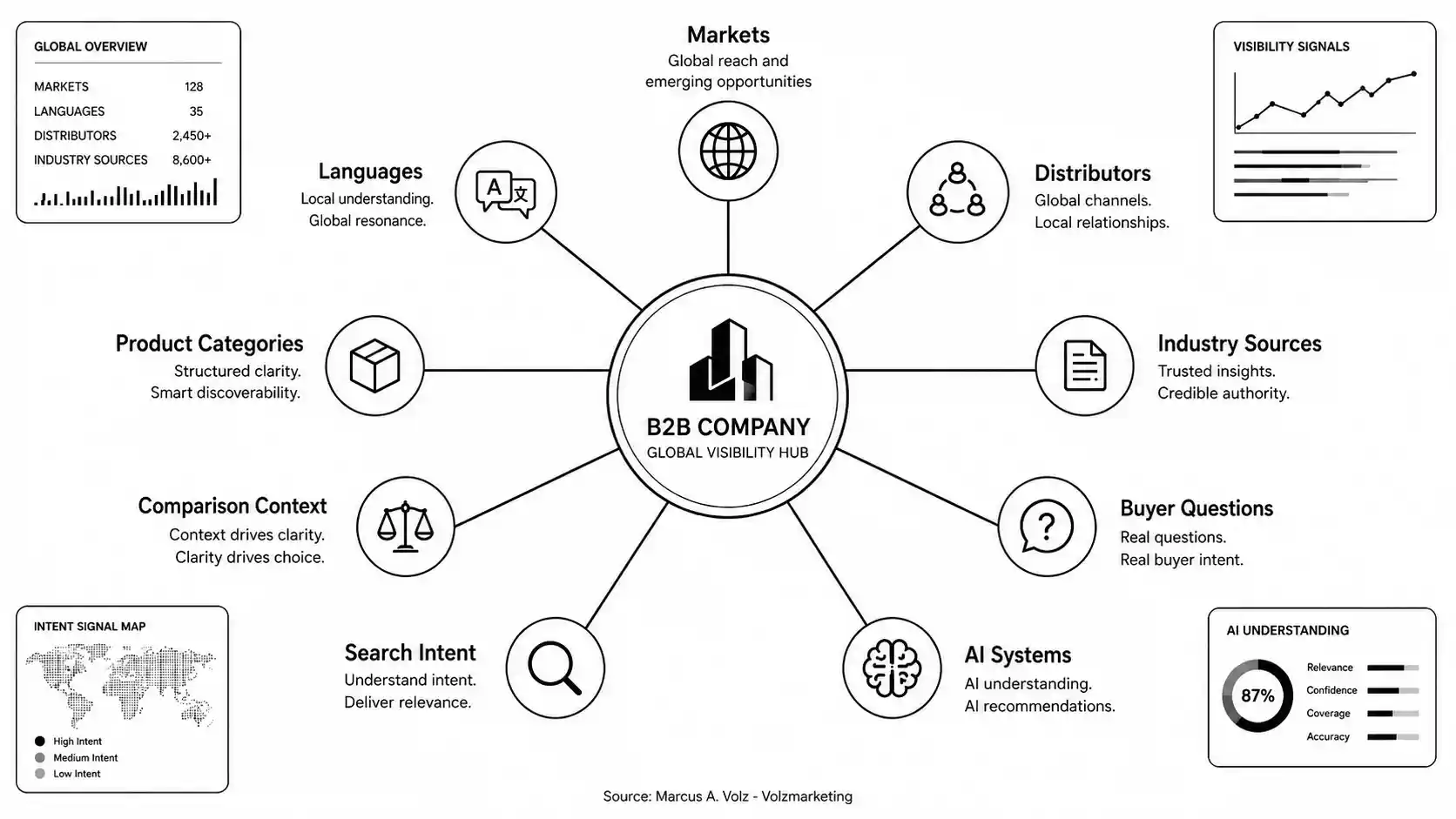
Granular optimization for AI visibility does not mean writing artificial content for ChatGPT, Gemini, Perplexity or Google AI Mode. It means positioning a company so precisely within market, search and decision contexts that search engines and AI systems can better understand its role in specific B2B questions.
For North American and European B2B companies, international visibility is not created by saying “we are a global supplier.” It is created where a company becomes understandable for a specific market, language, industry, application, buyer role and evidence environment.
The Core Thesis: AI Visibility Is Not Global, It Is Granular
AI visibility in international B2B does not result from one single optimization step, but from many specific context signals. Many companies still discuss AI visibility as if it were one uniform layer. In practice, that is too broad.
A North American industrial supplier may be clearly positioned in its domestic market and still be barely visible as a relevant option in Brazil, Chile, Argentina or Mexico. A European manufacturer may have strong technical expertise, but appear only through distributors, trade intermediaries or generic product categories. A B2B SaaS company may be well described in English, but weakly understood in Spanish or Portuguese answer environments.
International B2B visibility is therefore not built through one website, a few keywords or generic AI optimization. It is built through the precise connection of market logic, buyer questions, language, source environments and digital supplier perception.
How this fits into the VolzMarketing insight framework
This insight connects several VolzMarketing themes: Market-First SEO, B2B Search Intelligence, international B2B visibility and good rankings without AI visibility. The focus is not on AI as a trend, but on how companies become understandable in international search and answer systems.
Why “AI Optimization” Is Too Broad
The term AI optimization is too broad for international B2B visibility because companies are not optimizing the AI model itself. They are improving the machine-readable positioning of their business within specific market and buyer contexts. For international B2B markets, the idea of one technical lever is misleading.
Google’s guidance for AI Overviews and AI Mode does not describe a separate shortcut for generative visibility. It still emphasizes the basics: crawlable and indexable pages, visible text, internal links, suitable structured data, helpful content and clear page architecture. At the same time, AI systems can use query fan-out, meaning they may draw from several related questions and subtopics to construct an answer.
For B2B companies, this means that one central service page is usually not enough. The critical question is whether the relevant sub-questions, application contexts, comparison frames and source references are covered clearly enough.
Methodological source note
This analysis is aligned with current Google Search Central guidance and with AI search measurement frameworks that distinguish between visibility, structural readiness and business impact.
Side Question: Why is AI visibility measurement not enough?
AI visibility measurement only shows whether a company is mentioned. It does not explain why it is mentioned, whether the description is accurate or whether the mention matters for a real B2B decision. Prompt results must therefore be compared with search visibility, source quality, market logic, competitive context and buyer questions.
GEO_Fanout_Coverage of this analysis
This page covers the main fan-out questions around AI visibility in international B2B: market, language, industry, product category, buyer role, search intent, comparison context, source environment, distribution reality, distributor dominance, translation versus semantic localization, AI visibility measurement, content readiness and business relevance.
What Granular Optimization for AI Visibility Means in International B2B
Granular optimization for AI visibility is the structured preparation of content, entities, sources and internal page clusters for specific market and buyer questions. It does not make a company generically “AI-optimized.” It makes the company easier to interpret in the decision contexts that matter.
It does not ask: “How do we become visible in AI?”
It asks more precisely:
- For which target market should the company be understood?
- In which language is the buyer researching?
- Which industry and application context are relevant?
- Which buyer role is asking the question?
- Which competitors, distributors or local alternatives appear in the comparison?
- Which sources confirm the company’s market role?
- Which content helps an AI system classify the company correctly?
Granular AI visibility matters because international B2B decisions rarely begin with one search query. They develop through several layers of research: market understanding, technical requirements, availability, local presence, partner structure, references, regulatory questions and supplier evaluation.
The Main Granularity Layers
The main granularity layers show which contexts a company must cover so that AI and search systems can classify its B2B role more precisely. Each layer changes which sources matter, which questions buyers ask and which suppliers appear as relevant options.
| Layer | Guiding question | Why it matters for international B2B visibility |
|---|---|---|
| Market | Is the target market Brazil, Argentina, Chile, Mexico, Europe, the United States, Canada or another region? | Each market has its own search patterns, sources, competitors, distribution structures and buyer expectations. |
| Language | Is the research happening in English, Spanish, Portuguese, German or French? | Language changes terminology, answer logic, specialist sources and comparison frames. |
| Industry | Is the context machinery, mining, energy, agritech, pharma, SaaS or logistics? | AI systems need to understand the supplier role in industry-specific terms, not only as a generic B2B company. |
| Product category | Which solution, component, application or technical category is being evaluated? | Many companies are visible by product name, but not by buyer problem or application context. |
| Buyer role | Is the question asked by procurement, a distributor, an engineering lead, a business development team or an investor? | Each role changes priorities: price, availability, certification, service, references or local support. |
| Search intent | Is the buyer looking for orientation, comparison, supplier discovery, risk assessment or implementation? | A page must fit the decision stage, not just contain a keyword. |
| Comparison context | Who or what is the company compared with? | AI systems often produce shortlists, alternatives and comparison frames. Positioning must be robust enough to appear there. |
| Source environment | Which official, industry-specific or market-related sources support the claim? | Without internal and external evidence, the supplier role remains weak or difficult to cite. |
| Distribution reality | Is the manufacturer visible itself, or mainly through distributors, importers or local partners? | In international B2B, operational market presence can exist while digital brand perception remains weak. |
AI visibility is not global. It is granular: shaped by market, language, industry, buyer logic, sources and distribution reality.
Buyer-Uncertainty Evidence Layer: What B2B Buyers Are Really Unsure About
B2B buyer uncertainty emerges when a supplier exists, but is not clearly recognizable as a relevant option in market, search and AI systems. International B2B content must reduce that uncertainty systematically.
Segment Vocabulary
North American and European B2B buyers rarely search for abstract terms such as “AI Visibility” or “granular AI optimization.” They ask more concrete questions: Which suppliers exist for this application in this market? Is the company really active there? Are there local partners? Are technical requirements covered? Which sources confirm the company’s market role? Is the supplier understandable in the local language?
Comparison Logic
The relevant comparison is not “AI-optimized” versus “not AI-optimized.” The relevant comparison is: Is a supplier better understood in the target market than competitors, local distributors, platforms or generic industry sources? For manufacturers, it is especially important whether search engines and AI systems can distinguish between manufacturer, dealer, importer, integrator and local alternative.
Proof Layer
Granular visibility needs evidence. That includes clear service and product information, visible market references, internal topic clusters, official sources, industry sources, SERP and AI visibility observations, and consistent entity data for the company, author, brand and offer.
Observable Evidence
A reliable assessment should compare local Google results, AI answers, industry directories, distributor mentions, LinkedIn and company profiles, the company’s own page structure, external sources, product categories and language-specific buyer terms. Only then does it become visible whether a company is interpreted as a supplier, manufacturer, partner, distributor or simply as an unclear brand.
Related VolzMarketing analyses
For buyer uncertainty and distributor risk, these related insights are particularly relevant: The Partner Mistake, The Distributor Trap in Mercosur and Digital Market Strategies for EU Companies in Mercosur.
Why International B2B Visibility Is Not Just Translation
International B2B visibility is not a translation problem. It is a localization problem involving search intent, market logic, sources and buyer vocabulary. An English page can be accurate and still miss the search logic of a Spanish- or Portuguese-speaking market.
Terminology, sources, institutions, competitors and buyer questions differ by language environment. AI answers may also emphasize different sources, risks and priorities depending on language and regional context.
For North American and European B2B suppliers, this means that English, Spanish, Portuguese, German and French content should not only be translated. It must be semantically localized. This connects directly with international SEO for LATAM market entry and International SEO in Mercosur.
Side Question: Does every language need its own market logic?
Yes, when the language represents a distinct search and decision context. A Spanish or Portuguese page should not be a translated version of an English page. It should include local terminology, buyer questions, sources, industry logic and comparison contexts.
| Wrong assumption | Better view | Content implication |
|---|---|---|
| An English page is enough for international markets. | Language changes sources, search intent and answer frames. | Important markets need language- and market-specific decision pages. |
| Translation automatically creates visibility. | Translation moves words, not necessarily market logic. | H1, H2, examples, sources and FAQs must be reviewed by language and market. |
| All countries in a region work similarly. | Regions contain very different market and search systems. | Brazil, Argentina, Chile, Paraguay, Uruguay, Mexico, the U.S., Canada and Europe require separate visibility checks. |
| AI visibility can be measured centrally. | AI visibility depends on platform, language, market, prompt, user context and source environment. | Prompt tests must be documented by target market, language and buyer role. |
Digital market context pages
Digital market pages are relevant because they separate language environments, search behavior and regional market perception.
Content Strategies for Granular AI and B2B Visibility
Content strategies for granular AI visibility must reflect decision situations, not just collect topics or keywords. The central task is simple: every important page should answer a specific market, buyer or comparison question.
Content strategy is the operational lever for building granular visibility. The goal is not mass content production, but a clear architecture of hub pages, market pages, industry clusters, application pages, FAQ blocks and evidence sources.
They explain how a target market works: demand, distribution logic, sources, competitors, regions, regulatory specifics and digital search environments.
They show how an industry is researched and evaluated in the target market: machinery, mining, energy, agritech, pharma, SaaS or logistics.
They connect product categories with concrete use cases, buyer problems, technical requirements and decision criteria.
They provide evidence: official sources, industry sources, market data, proprietary analysis, SERP observations and AI visibility checks.
They answer follow-up questions that buyers or AI systems may ask after the first answer.
They clarify who is speaking, what the brand stands for, which markets are covered and what role the company has in the topic area.
Related content and SEO foundations
The following pages support the strategic framework, content logic and quality assurance behind granular AI visibility.
What a Granular Page Architecture Can Look Like
A granular page architecture connects central hubs with precise market, industry, application and proof pages. It helps search engines and AI systems understand a company not only as a brand, but as a relevant supplier option in specific decision situations.
A strong architecture begins with a central hub page that brings the topic together. Below it, more specific pages or sections cover markets, industries, applications and decision contexts.
| Page type | Function | Example for international B2B visibility |
|---|---|---|
| Strategic hub | Explains the overall model and connects subtopics. | International B2B Visibility or Market & Search Intelligence. |
| Market page | Frames a target market with search, source and buyer logic. | B2B visibility in Brazil, Argentina, Mexico, the United States, Canada or Mercosur markets. |
| Industry page | Shows how an industry is researched and evaluated in a market. | Mining, energy, machinery, agritech or SaaS in South America. |
| Use-case page | Connects offer, application and buyer problem. | Industrial equipment for local integrators, mining suppliers or export logistics. |
| Insight | Provides market observation, thesis, proof and business implication. | Why distributor dominance can hide a manufacturer’s AI visibility. |
| Monitoring page or report | Documents measurement logic, prompts, sources, competitors and changes. | B2B Visibility Report or AI Search Visibility Analysis. |
Relevant hub and report pages
A granular architecture should be connected internally with diagnostic and reporting pages.
Example: Mercosur and South America as an Application Context
Mercosur and South America show particularly clearly why granular AI visibility must be assessed by country, language, industry and distribution reality. Many North American and European companies still look at these markets too broadly.
“South America” is not a sufficient visibility category. Brazil works differently from Argentina. Chile is not Mercosur. Paraguay and Uruguay have different market sizes, trade logics and digital source environments. Local distributors, industry portals, import logic and language effects often determine whether a foreign supplier appears as a relevant option at all.
For VolzMarketing, Mercosur is therefore not a narrow niche. It is a concrete application context: a place where the connection between Market Intelligence, International SEO, Search Intelligence and AI visibility becomes visible.
The strategic question is not:
“Are we internationally visible?”
It is:
“Are we recognized as a relevant option in the right market, in the right language, for the right buyer question, with the right source environment?”
Mercosur and South America context
For regional context, this insight connects to existing country, market-entry and industry clusters.
What Companies Should Check First
Companies should first check whether they are correctly visible in the relevant market, language, industry and buyer questions. A granular assessment does not start with tools. It starts with clear questions.
Only then should teams test how Google, AI Mode, ChatGPT, Gemini, Perplexity, Claude or other systems classify the company.
| Assessment layer | Guiding question | Typical finding |
|---|---|---|
| Presence | Does the brand appear in relevant AI answers at all? | The company is not mentioned, even though it may be technically relevant. |
| Recommendation | Is the brand merely mentioned or actively recommended as a suitable option? | Competitors or distributors appear more strongly than the manufacturer itself. |
| Linked citation | Is a specific page linked or cited as a source? | The brand may be mentioned, but without a reliable link to the company’s own website. |
| Representation accuracy | Is the company described correctly? | The AI system confuses supplier role, market, product category or target group. |
| Readiness | Are content, structure, sources and entities sufficiently prepared? | The website contains information, but not in clear, citable decision blocks. |
| Business impact | Are there indications of leads, better prequalification or more qualified inquiries? | AI visibility may exist, but the business effect is not yet measurable. |
Relevant assessment and monitoring pages
For concrete assessment, these pages connect market reality, search visibility, digital market signals and monitoring.
Why Distributor Dominance Is a Specific B2B Risk
Distributor dominance is a specific B2B risk because it can shift digital supplier perception from the manufacturer to local intermediaries. In many international B2B markets, manufacturers work through distributors, importers, integrators or local sales channels.
If local partners are more visible than the manufacturer, search engines and AI systems may learn the distributor as the primary supplier. The manufacturer brand then remains weak, difficult to classify or only findable through product searches.
This issue is central to the analysis The Distributor Trap in Mercosur. The logic is especially important for granular AI visibility: a brand can be operationally present in a market and still disappear behind dealer, importer or platform signals.
Side Question: How can a distributor weaken a manufacturer’s AI visibility?
A distributor can weaken a manufacturer’s AI visibility when search engines and AI systems interpret the local partner as the primary supplier. The manufacturer may be indirectly present in the market, but not necessarily appear as an independent option in supplier questions, shortlists or comparison answers.
Granular optimization for AI visibility must therefore clarify whether the brand itself is machine-readable in the target market: as manufacturer, solution provider, technology partner, exporter, supplier or specialized B2B company.
What Granular Optimization for AI Visibility Is Not
Granular optimization for AI visibility is not a guarantee, not a trick and not an artificial mention strategy. No one can seriously guarantee that a company will be named in every AI answer.
Granular optimization for AI visibility is a structured method to make real market, search and decision logic more visible.
The method does not replace solid SEO, helpful content or real market analysis.
AI answers depend on platform, model, prompt, language, sources and user context.
Granularity does not mean creating a separate page for every possible query variant.
AI visibility must be connected with market logic, buyer questions, source quality and business relevance.
How VolzMarketing Assesses Granular AI Visibility
VolzMarketing evaluates granular AI visibility as the interaction of Market Intelligence, Search Intelligence, International SEO, source logic and AI Visibility. The question is not only whether a company ranks or appears in an AI answer.
The decisive point is whether the representation is accurate, market-specific, source-based and commercially relevant.
| Analysis area | What is assessed | Why it matters |
|---|---|---|
| Market Reality | Target market, industry structure, local demand, competitors, distribution paths and regional differences. | Without market logic, visibility remains superficial. |
| Search Visibility | Google visibility, local search terms, SERP structure, language variants and internal page architecture. | Classical search remains a foundation for AI-assisted visibility. |
| AI Visibility | Prompt coverage, recommendations, citations, answer frames, platform differences and source logic. | Shows whether a supplier is considered in AI-assisted research. |
| Entity Fit | Consistency of brand, author, organization, service description, markets and external profiles. | Unclear entities lead to weak or inaccurate machine interpretation. |
| Content Readiness | Quick answers, H2/H3 structure, FAQs, proof blocks, internal links and self-contained passages. | Increases the chance that individual sections can be understood, extracted and cited. |
| Business Relevance | Which decision is being prepared: market entry, partner assessment, visibility build-up, monitoring or correction. | Visibility only matters if it supports a real business decision. |
Relevant VolzMarketing service pages
This analysis connects with VolzMarketing services around Market & Search Intelligence, AI Search Visibility Analysis and international B2B visibility.
Which Audiences Are Especially Affected?
The most affected audiences are B2B companies whose market role requires explanation and whose buyers do not simply search for a known brand. The more complex the offer, market and distribution system, the more important granular AI visibility becomes.
They need to assess whether a company is not only capable of supplying a market, but also digitally recognizable as a suitable option.
They need to structure content so that market, industry, product and buyer logic becomes understandable for users and for search and answer systems.
They need a realistic view of whether international visibility supports their market position or only exists on the surface.
They need to know whether the manufacturer brand remains visible or whether local dealers, importers and platforms dominate digital perception.
Which Types of Companies Are Most Affected?
Granular optimization for AI visibility is especially relevant for companies with complex offerings and buyers who do not simply search for a known brand. This affects manufacturers, suppliers, SaaS companies and companies before or during international expansion.
| Company type | Typical problem | Granular visibility question |
|---|---|---|
| B2B manufacturers | The distributor is visible, but the manufacturer brand is weak. | Is the manufacturer recognized as an independent supplier option in the target market? |
| Industrial and machinery suppliers | Products exist, but application contexts are missing. | Is the offer visible for concrete technical buyer questions? |
| Mining, energy and infrastructure suppliers | Project and industry context is complex. | Can an AI system correctly classify the supplier role in the market or project context? |
| Agritech, food and pharma suppliers | Regulatory, local and industry-specific terms are not covered clearly. | Does the content match the language and source logic of the target industry? |
| SaaS and technology companies | The product is described globally, but not locally anchored. | Is the offer understood as a relevant category in the local language? |
| Companies before market entry | There is no strong local presence yet. | Which content and sources must be built so that the market role becomes understandable early? |
Industry clusters for granular visibility
Granularity should not only be mapped by country, but also by industry. These industry clusters are particularly relevant.
Common Mistakes in International AI Visibility
The most common mistakes happen when companies treat AI visibility as a tool issue instead of a market, content and source issue. Many companies underestimate how strongly AI answers depend on existing sources, search systems and semantic patterns.
- They translate content without checking local search and decision logic.
- They create generic country pages without industry, buyer role and use-case specificity.
- They rely on distributors without monitoring the manufacturer’s own brand perception in the target market.
- They measure rankings, but not AI mentions, citations, answer frames and representation accuracy.
- They write too broadly and fail to answer clear follow-up questions.
- They use schema without making sure the visible page content supports the claims.
- They publish content without source blocks, author context, internal linking and monitoring.
Further examples of visibility and interpretation risks
The following insights show related patterns: wrong market interpretation, weak brand perception, AI visibility without real substance or digital signals that can be misread.
The Practical Consequence for North American and European B2B Companies
North American and European B2B companies should treat AI visibility as an early indicator of how a market digitally understands them. If a company is not visible in specific market, industry and buyer questions, it may not be considered in early research processes.
This can happen even if the company is technically strong, export-ready and operationally capable.
Granular optimization for AI visibility therefore helps answer one strategic question: Where is a company already understandable, findable and credible — and where is the semantic, market-specific or source-based foundation still missing?
Further VolzMarketing analyses
These topics complement the logic of granular AI and B2B visibility described in this insight.
Frequently Asked Questions About Granular Optimization for AI Visibility in International B2B
What is granular optimization for AI visibility?
Granular optimization for AI visibility is the structured alignment of content, sources, entities and page architecture with specific market, language, industry, buyer and search contexts. The goal is not manipulation, but better understandability in search engines and AI-assisted answer systems.
Why is granular AI visibility important for international B2B companies?
International B2B companies are searched and evaluated differently depending on market, language, industry and buyer question. A general company description is often not enough for search engines and AI systems to recognize the supplier role in specific target markets.
Is granular optimization for AI visibility the same as GEO?
Not exactly. GEO is often understood as optimization for generative search systems. Granular optimization for AI visibility is more closely tied to market logic: it asks in which specific decision contexts a company must be visible, citable and correctly represented.
What role does classical SEO play?
Classical SEO remains a foundation. Content must be crawlable, indexable, internally linked, clearly structured and helpful for users. Without solid search visibility, it is harder to appear as a source or supplier option in AI-assisted answer systems.
Why is translation not enough for international AI visibility?
Language changes search terms, sources, institutions, comparison logic and buyer expectations. A translated page can be accurate and still miss local search and answer logic. International visibility therefore requires semantic localization.
Which content supports granular visibility?
Important elements include clear market pages, industry pages, application pages, FAQ and side-question blocks, proof sources, internal links, author and organization context, and visible answer passages that answer individual buyer questions independently.
Why is the distributor trap relevant for AI visibility?
If a distributor, importer or local partner is digitally more visible than the manufacturer, search engines and AI systems may misread the market. The manufacturer may be operationally present, but not recognized as an independent supplier option.
Can AI visibility be guaranteed?
No. AI answers depend on platform, model, prompt, language, user context, source environment and search systems. A serious approach is therefore not a guarantee, but a structured assessment and improvement process.
How can VolzMarketing support this process?
VolzMarketing assesses international B2B visibility along market logic, search visibility, AI mentions, source environments, entity context, content structure and business relevance. The result is a set of concrete recommendations for page architecture, content strategy, monitoring and market positioning.

Assess granular B2B visibility
VolzMarketing helps companies assess market logic, search visibility, AI mentions, source environments and international supplier perception in a structured way.
Request an analysis