
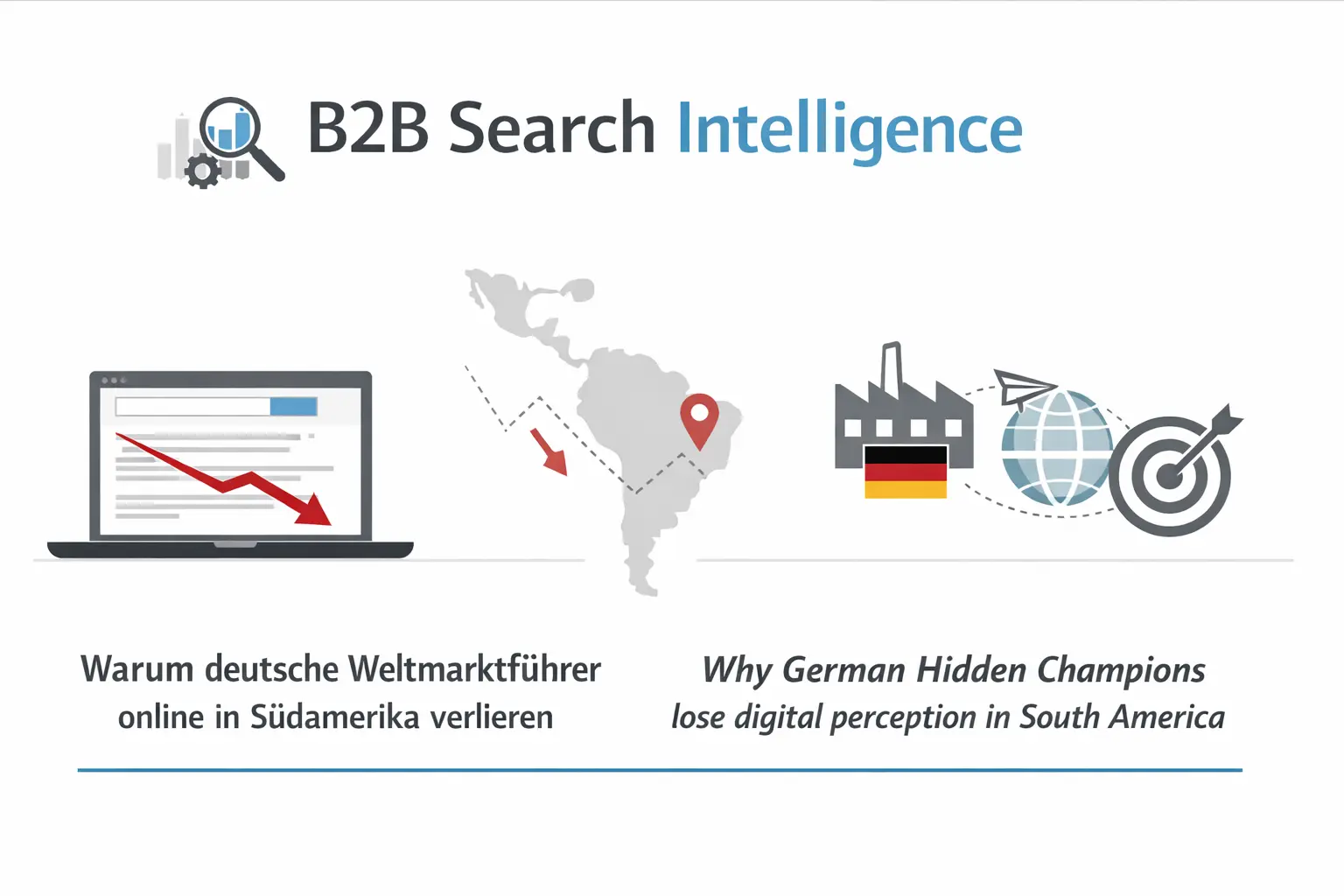
Why German Hidden Champions Are Digitally Underrepresented – And How B2B Search Intelligence Changes That
Operational presence doesn't equal digital visibility. How industrial market leaders in South America disappear before machine-driven preselection – and what can be done about it.
Executive Summary: German hidden champions are operationally strong in South America – but structurally underrepresented in the digital decision space. Distributors dominate Google search results. AI systems mention local competitors, not the market leader. This is a market signal problem. Those who don't appear in machine-driven preselection won't make the longlist – regardless of technical superiority.
A machinery specialist from Baden-Württemberg. Global market leader in its niche. €180 million revenue in Chile over three decades. Locally known, technically superior, operational excellence.
A procurement manager in Santiago searches: "equipos industriales bombeo".
Positions 1-3: Local distributors. Positions 4-7: Chilean competitors. Positions 8-10: Brazilian suppliers.
The German market leader? Not visible.
Presence is not perception. German B2B companies treat digital presence as a marketing add-on, not as market infrastructure. The strategic gap: They are really there – but digitally invisible.
Market Reality: System vs. Assumption
German hidden champions operate successfully in South America – but according to a system that isn't structurally represented in digital systems:
- Sales via distributors: Local partners handle customer relationships and technical support
- Limited local content (ES/PT): Product documentation exists in German or English
- Technical data not structurally findable: PDF catalogs instead of machine-readable specifications
- Regional competitors with higher content density: Local providers continuously produce Spanish/Portuguese content
This works operationally – has for decades. But it doesn't work digitally.
The central insight: Presence ≠ Perception.
A company can be present in a market for 30 years, technologically leading, economically successful – and still digitally nonexistent if the perception layer isn't systematically addressed.
AI and Search System Interpretation: Machine vs. Human
Search engines and AI systems interpret markets differently than humans. They don't evaluate reputation or operational strength – they evaluate signals:
- Missing Spanish/Portuguese entities: No local brand mentions, no regional product categories
- Distributor domains dominate SERPs: Local partners rank for product categories – not the manufacturer
- Minimal local backlink structures: No connections to industry portals, trade media, industry databases
- Weak semantic connection to regional industries: No content on local use cases, compliance standards, industry specifics
The consequence: ChatGPT names Brazilian competitors. Perplexity lists Chilean alternatives. Google shows distributors.
The market leader? Not interpreted as relevant by machines.
Methodological Testing: How Diagnosis Works
The diagnosis isn't based on assumptions, but on four measurable dimensions:
Four-Dimension Diagnosis
Which domains appear for local search terms? Manufacturers, distributors, or competitors? Geographic attribution of rankings shows who is interpreted as locally relevant.
Which semantic entities (products, applications, industries) are linked to the brand? Are there local terms, norms, standards in the content?
Does the website cover local technical terminology? Is there content on regional use cases, industry specifics, compliance requirements?
Identical query to ChatGPT/Perplexity in German and Spanish: Is the company mentioned? In what context? Categorized as local or international solution?
This test shows not only whether a company is visible – but how it's interpreted.
Case Study: Pump Manufacturer in Chile
Anonymized German Machinery Specialist
Initial Situation
Company:
- Global market leader in industrial pump systems
- 30+ years operational presence in Chile
- €180M revenue via three local distributors
- Technologically unmatched in specialized applications
Digital Reality:
Test Result: Search "equipos industriales bombeo minería Chile" – Positions 1-10 all distributors or local competitors. ChatGPT (Spanish): "Para aplicaciones industriales en Chile, las principales marcas son..." – German manufacturer not mentioned.
Diagnosis
SERP Geography: Distributors rank for all relevant keywords. Manufacturer domain categorized as "German/international," not "Chilean relevant." No local backlinks.
Entity Gap: Product pages in German/English – no Spanish entities. No connection to local application areas (minería, industria química, tratamiento de aguas). Technical specifications not machine-readable.
Technical Term Coverage: No content on Chilean norms (NCh), no local use cases, no content anchoring in regional specialized topics.
AI Interpretation: ChatGPT categorizes as "German industrial solution for large corporations." Perplexity lists local alternatives as "available solutions in Chile." No association with Chilean market despite 30 years of presence.
Implementation (6 Months)
Semantic Anchoring: Building Spanish product categories with local terminology. Content series on Chilean use cases (mining, chemicals, water treatment). Integration of local norms (NCh 1333, NCh 691). Schema.org markup for correct categorization as "Industrial Equipment Chile."
Structured Data: Technical specifications prepared in machine-readable format. Product database with Spanish entities. Connection to local industry categories.
Local Presence Signals: Case studies of Chilean projects (anonymized). Backlinks from Chilean industry portals. Integration into local B2B directories. Content governance framework with distributors.
Results (12 Months Post-Launch)
Most Important Change: ChatGPT (Spanish) now names the German manufacturer in 67% of queries as "leading provider for industrial pumps in Chile." Perplexity lists it as the first international alternative for specialized applications.
Operational Impact: Three new major projects with direct digital contact. Procurement manager: "We knew you were here – but we couldn't find you online."
Methodological Context: The example shown here is part of a structured international market signal audit – a systematic diagnostic process for B2B companies with operational presence but missing digital visibility.
The Structural Distributor Risk
When distributors dominate SERPs, the manufacturer has no independent digital market presence. The entire online perception lies in foreign hands.
The risk: In case of contract changes, conflicts, or strategic realignments, digital existence disappears overnight – including customer journey, product information, and brand authority in the target market.
German hidden champions have underestimated this concentration risk for years because operational sales relationships were stable. But digital perception works differently than personal business relationships: It's structurally dependent on domains, content, and backlink architectures.
This isn't a marketing problem, but a strategic concentration risk. Those who don't build their own digital market infrastructure lose control over their brand perception – regardless of operational strength.
Implications for Decision-Makers: The Market Signal Problem
Those not correctly anchored digitally lose perception before first contact – before sales, before trade shows, before tenders.
This is a market signal problem. Those who don't appear in machine-driven preselection won't make the longlist – regardless of technical superiority.
Traditional Understanding
- Operationally present = perceivable
- Sales solves visibility
- Brand is known (to existing customers)
- Distributors represent
Digital Reality
- Operationally present ≠ digitally visible
- Machine preselection before sales
- Brand is unknown (to AI systems)
- Distributors displace in SERPs
The critical insight: Those who don't appear in machine-driven preselection won't make the longlist – regardless of technical superiority, operational presence, or historical track record.
The digital decision space operates by different rules than the operational sales space. Both spaces must be synchronized.
Solution: B2B Search Intelligence
B2B Search Intelligence is strategic market signal architecture.
Four Layers of Systematic Market Perception
1. Systematic Market Signal Analysis
- SERP geography mapping: Who is visible where?
- Entity gap diagnosis: What semantic gaps exist?
- AI interpretation audit: How do systems categorize the brand?
- Competitor content intelligence: How do local players position themselves?
2. Local Semantic Anchoring
- Building local entities (products, applications, norms)
- Content strategy for regional use cases
- Integration into local industry narratives
- Semantic connection to industry specifics
3. Structured Data & Entity Building
- Machine-readable product specifications
- Schema.org markup for correct categorization
- Local backlink structures (industry portals, trade media)
- Technical databases instead of PDF catalogs
4. Governance Instead of One-Off Measures
- Content governance between manufacturer and distributors
- Continuous monitoring of AI visibility
- Systematic updates instead of one-time campaigns
- Integration into existing sales structures
B2B Search Intelligence operates at the decision layer – not at the content agency level. It's not about rankings, but about market perception before the decision.
The Closing Question
Operational strength is no guarantee of digital visibility.
The question isn't whether you're there – but whether systems know it.
German hidden champions have invested decades in operational excellence. They've built local partnerships, developed technical superiority, established reliable sales structures.
But they've failed to encode their presence as market signals.
The result: Invisibility where decisions are prepared – in search engines, in AI response systems, in machine-driven preselection.
B2B Search Intelligence solves this problem systematically. Not through more content. But through structured market signal architecture at the decision layer.
B2B Search Intelligence in Practice
The diagnosis and implementation of systematic market signals described here is a core service I provide.
Typical projects include:
- Market Signal Audits: Four-dimension diagnosis for target markets
- Entity Gap Analyses: Which semantic gaps prevent AI visibility?
- Content Governance Frameworks: Collaboration between manufacturers and distributors
- Implementation Roadmaps: Structured data, local anchoring, AI optimization
More information on B2B Search Intelligence:
→ B2B Search Intelligence
Are you operationally present in your target markets – but digitally invisible?
Let's diagnose your digital market perception and structurally anchor it – before your competitors win at machine-driven preselection.
Contact: info@volzmarketing.com