
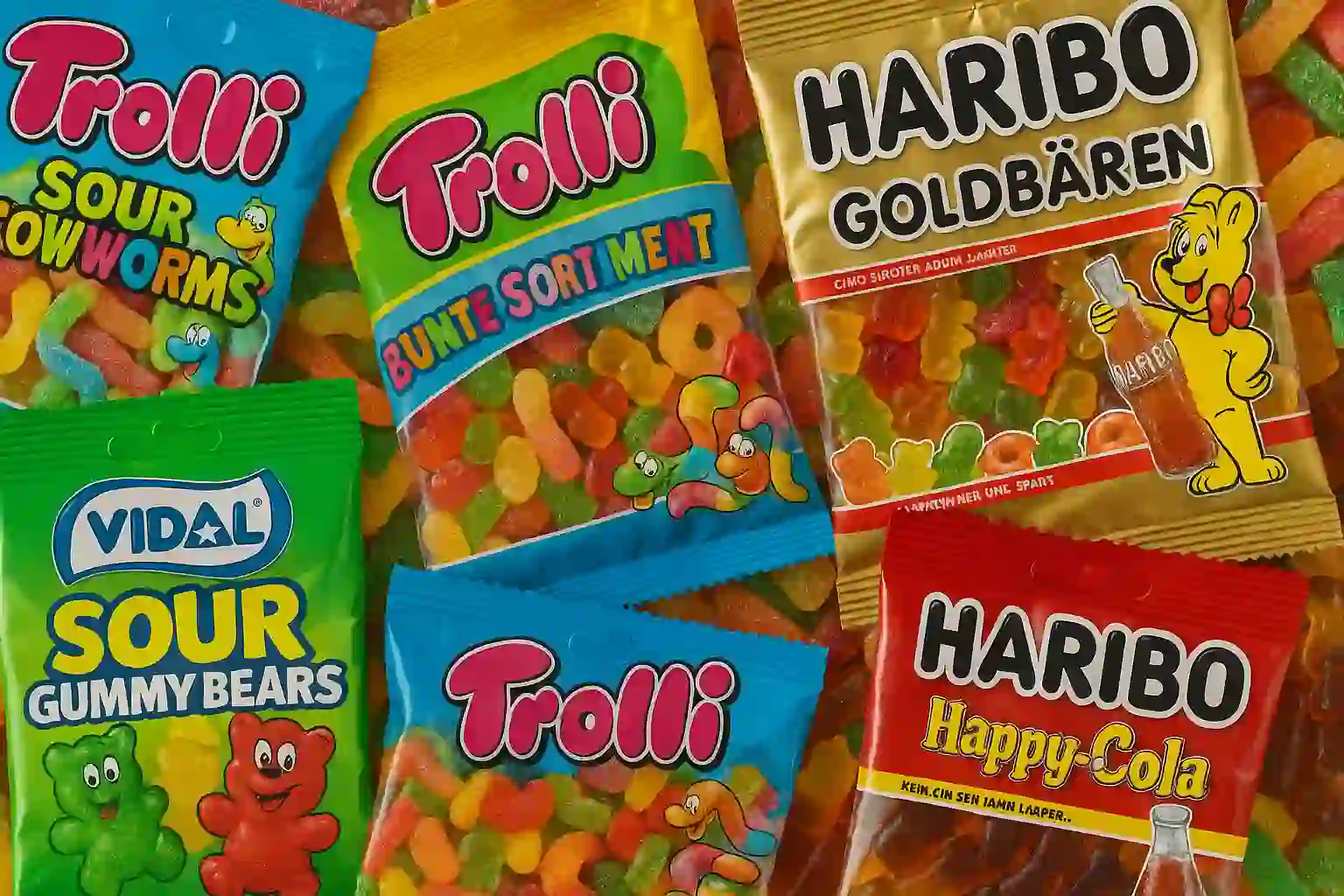
The Trolli Paradox: Why Brands Exist in AI But Aren't Found Locally
Case Study: How a global candy brand becomes invisible in Spain – despite millions in revenue and AI presence
Trolli sells millions of gummy candies in Spain. The brand is present in retail, consumers know the products, revenue is generated. But when a user in Madrid searches Google for "mejores gominolas" (best gummy candies) or asks ChatGPT for recommendations, Trolli doesn't exist.
At the same time, Trolli is reliably recognized and correctly categorized in global AI systems – as an international candy brand with a broad product portfolio.
A brand can be globally visible to AI systems – and simultaneously practically non-existent in local search markets.
The Guiding Question
The central question for international brands today is no longer:
"Are we known?"
but rather:
"Are we locally modeled as a market entity digitally – in a way that search engines and AI systems understand us?"
The Trolli case shows what happens when the answer is "No."
The Facts: Trolli in Spain
Analysis Metrics
Study Period: October–December 2024
Target Markets: Spain (trolli.es) vs. global AI systems
Methodology: Google Search Console, AI Perception Analysis, Competitor Comparison
Google Visibility: The website trolli.es practically doesn't rank on Google Spain for central search terms like "gominolas" (gummy candies), "gominolas ácidas" (sour gummy candies), or related product categories. Competitors like Haribo, Fini, or Vidal dominate these terms with structured, content-rich pages.
Local AI Visibility: For Spanish-language queries to ChatGPT, Perplexity, or Google SGE, the systems rarely draw on content from trolli.es. Instead, they cite Wikipedia, international e-commerce platforms, or competitors.
Global AI Visibility: For general questions about candy brands or gummy candies, Trolli is correctly recognized as an international brand – based on global sources like Wikipedia, LinkedIn, or the international corporate website.
of consumers use AI systems for product research in 2025 – compared to 38% in 2024.
(Source: Gartner Consumer Trends Report 2024)
Why This Is Critical
Purchase decisions rarely begin at the shelf today. Studies show that 70–85% of decisions are prepared online in advance, even for traditional FMCG products.
Users search for:
- "mejores gominolas" (best gummy candies)
- "gominolas para fiestas infantiles" (gummy candies for children's parties)
- "qué marca de gominolas es mejor" (which gummy candy brand is best)
Increasingly, these questions are asked not just via Google, but directly through AI systems like ChatGPT, Google SGE, or Perplexity. These systems don't provide link lists, but concrete recommendations.
The consequence: If a brand doesn't appear in this phase, it factually doesn't exist for the consumer – regardless of how present it is in physical retail.
AI systems increasingly function as gatekeepers: They pre-filter brands, recommend alternatives, and shape perception before a store is even entered.
The Causes: Classic SEO Deficits with AI Impact
The analysis shows no exotic technical problems, but classic local SEO deficits that today directly impact AI visibility:
1. Insufficient Content Depth
Product pages with around 150 words provide neither Google nor AI systems with sufficient context. Competitors work with 400–600 words and structured detail depth: ingredients, flavors, uses, origin.
AI Impact: Without context-rich sources, AI systems cannot qualify or categorize Trolli products.
2. Wrong Language Level
Using English product names ("Sour Brite Crawlers") without Spanish equivalents prevents connection to local search queries like "gominolas ácidas" (sour gummy candies).
AI Impact: AI systems match queries semantically – without the linguistic bridge, no connection is made.
3. Missing Structured Data
Without Schema.org markup for products, categories, and organization, machine-readable signals for search engines and AI models are missing.
AI Impact: Structured data is training material for AI systems – without it, the brand remains incomprehensible.
4. No Local Entity
There's no clearly modeled entity "Trolli España" with local market reference, distribution, production sites, or history.
AI Impact: AI systems understand entities, not websites. Without a local entity, there's nothing they can reference.
5. Flat Site Architecture
Missing categories, thematic clusters, and internal linking structures prevent building semantic depth.
AI Impact: AI systems also evaluate authority through semantic interconnection – flat structures signal low relevance.
The Concept: The Semantic Localization Gap
Visualizing the Semantic Localization Gap
Trolli exists in Wikipedia, LinkedIn, international sources.
AI systems recognize the brand globally.
No local modeling.
No rankings.
No quality sources.
AI relies on third parties.
Trolli España doesn't exist as a digital market entity.
Invisible to local search.
The Semantic Localization Gap describes the gap between a globally known brand that exists in AI systems, and a locally non-modeled market entity that isn't tangible to search engines and AI.
Within this gap, the following happens:
- Google cannot build local rankings
- AI systems fall back on third-party sources
- The brand loses control over its digital narrative
- Competitors with clean local structure systematically gain visibility
The causal chain is clear:
Missing local SEO structure → No Google rankings → No quality local sources → Low or incorrect AI representation
Why Offline Strength Alone No Longer Suffices
Trolli – like many established FMCG brands – has long successfully relied on physical presence: shelf placement, POS marketing, retail partners. This strategy continues to work, but reaches limits once the preliminary decision phase occurs digitally.
The shift is fundamental:
- Previously: Consumer enters store → sees product → decides
- Today: Consumer researches online → forms preference → validates at POS
Brands without digital and semantic anchoring systematically lose relevance in the first phase – regardless of their real market position.
Strategic Classification: Not an AI Problem, But a Structural Problem
The Trolli case clearly shows: Low AI visibility is almost always a consequential problem of poor local SEO structures.
This also means: The solution doesn't lie in "AI optimization," but in clean local modeling.
The Solution Process: Three Strategic Steps
1Build Local Entity
Modeling "Trolli España" as an independent market entity with:
- Local business profile (Google Business, structured data)
- Market-specific history and product adaptations
- Distribution structure and availability
- Local social proof (reviews, mentions, media)
2Create Semantic Depth
Building context-rich, linguistically adapted content:
- Product pages with 400–600 words (ingredients, uses, flavors)
- Spanish terminology parallel to product names
- Thematic clusters (children's birthdays, candy trends, recipes)
- Schema.org markup for all product categories
3Secure Platform Control
Active presence on relevant platforms:
- Marketplaces (Amazon.es, El Corte Inglés Online)
- Review portals and food communities
- Local media and influencer collaborations
- Monitoring: Where is the brand mentioned? What narratives emerge?
Implementation details are documented on volzmarketing.com under AI Market Intelligence.
What Other FMCG Brands Can Learn
The Trolli case isn't isolated, but symptomatic of many international brands:
- Globally strong
- Locally digitally weak
- Dependent on third-party platforms
- Barely controllable in AI responses
Similar patterns appear with:
- European beverage brands in LATAM markets
- Asian electronics manufacturers in Southern Europe
- US snack brands in Germany
The mechanics are identical: Global recognition doesn't compensate for missing local semantic structure.
Those who ignore this development risk long-term:
- Declining organic demand
- Increasing dependence on paid media
- Weaker negotiating position with retail partners
- Loss of brand sovereignty in digital space
How This Analysis Works in Practice
This article is an English summary of a comprehensive case study on marcus-a-volz.com.
→ Read the complete in-depth analysis here:
AI Visibility Without Google Rankings: The Trolli Paradox
AI Market Intelligence in Practice
Analyzing Semantic Localization Gaps requires:
- Systematic AI Perception Audits (how is the brand represented in various AI systems?)
- Local Search Visibility Mapping (where does the brand exist digitally, where not?)
- Competitor Entity Analysis (which competitors occupy the semantic spaces?)
- Gap-Closing Strategy (which structures need to be built?)
This work is core to my services at VolzMarketing.
On volzmarketing.com/en/services/ai-market-intelligence/ I document methodology, processes, and typical deliverables for companies looking to systematically build their AI visibility.
Conclusion
The Trolli case impressively shows how digital visibility has changed. Brands no longer automatically exist where they're physically present. They exist where search engines and AI systems understand them semantically.
The crucial question for international companies is no longer "Are we known?", but: "Are we locally modeled as a market entity digitally?"
Those who cannot clearly answer "Yes" to this question will become increasingly invisible in AI-powered search and recommendation systems – regardless of size, recognition, or offline strength.
AI Market Intelligence for FMCG Brands
The described analysis of the Semantic Localization Gap and strategic closing of these gaps is one of my core services at VolzMarketing.
Typical projects include:
- AI Perception Audits: How is your brand represented in various AI systems?
- Local Entity Gap Analysis: Where is semantic modeling missing?
- Competitor Entity Mapping: Who occupies the relevant semantic spaces?
- Structured gap-closing strategies prioritized by market relevance
More information about my services:
→ AI Market Intelligence
Your brand is strong in retail – but digitally invisible?
Let's analyze your AI visibility and local digital presence.
Contact: info@volzmarketing.com