
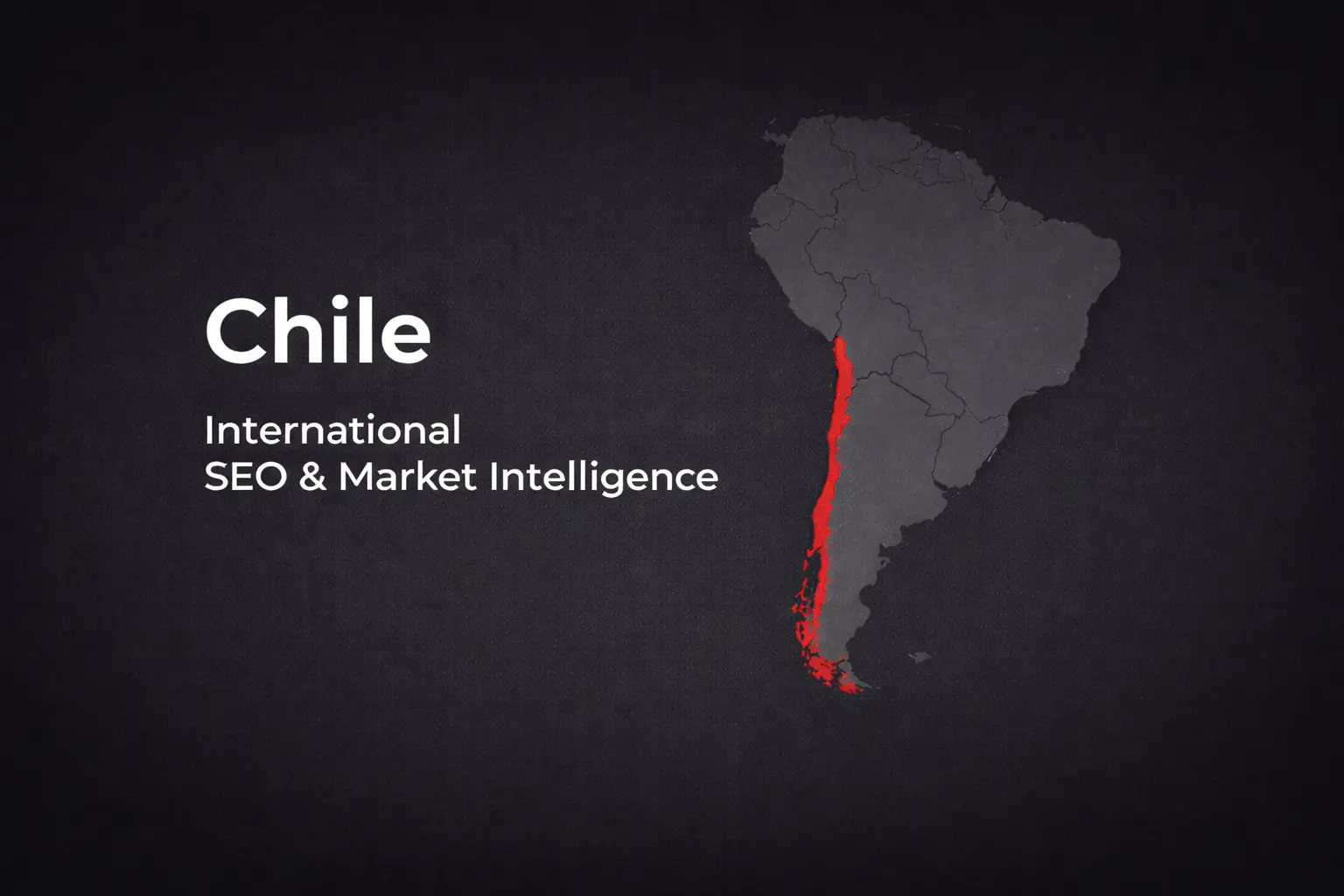
International SEO for Chile – Stability, Scalability and Strategic Market Logic
While Argentina functions as an early indicator under stress and Brazil represents a closed platform ecosystem, Chile is the market where classic international SEO models work best – provided they are cleanly localized and strategically embedded.
This analysis is based on international SEO and market intelligence consulting for companies with market entry and scaling projects in Chile and other Latin American markets.
Chile vs. Volatility Markets: The Stability Difference
Chile's unique position becomes tangible in numbers. The market shows fundamental differences from volatile LATAM markets:
| Indicator | Chile | Argentina (Comparison) | What This Means |
|---|---|---|---|
| Inflation Rate 2024 | 4.2% | 193% | Predictable pricing structures |
| Currency Stability | +/- 8% vs. USD | -54% vs. USD | Stable conversion funnels |
| Keyword Intent Half-life | 18+ months | 6-8 weeks | Long-term SEO works |
| Mercado Libre Dominance | 41% | 78% | Google remains relevant |
| Brand Search Share | 34% | 12% | Higher brand loyalty |
| E-Commerce Growth YoY | 18% | 62% | Structural, not reactive |
Sources: Banco Central de Chile, Cámara de Comercio de Santiago (CCS), INDEC Argentina, SimilarWeb LATAM Report (as of Q3/Q4 2024)
These numbers tell a clear story: Chile functions as a stable market with predictable user behavior. International strategies that rely on long-term SEO impact find ideal conditions here. The percentage values used here are based on aggregated market studies, platform data and insights from international consulting projects in Chile.
Specifically: A keyword like "software gestión proyectos" maintains 18+ months of relevance and search volume consistency in Chile. In Argentina, the same intent would be changed after 6-8 weeks through macroeconomic shifts.
Why Chile Is Not a "Small LATAM Market"
Many international teams systematically underestimate Chile: The market appears small compared to Brazil (215M) or Mexico (130M), is often viewed as a "pass-through market", and LATAM is wrongly seen as a homogeneous block.
The reality: 19 million inhabitants, but the highest purchasing power per capita in Latin America. 87% internet penetration, structural 18% e-commerce growth and digital infrastructure approaching European standards.
Digital and Economic Framework Conditions
Compared to other LATAM markets, Chile shows a rare combination of digital maturity and macroeconomic stability:
- High internet and smartphone penetration: 87% of population online, 89% mobile-first
- Stable currency in regional comparison: Peso CLP fluctuates +/- 8% vs. USD (vs. -54% Argentina)
- Functioning payment and logistics systems: Webpay, Mercado Pago, international credit cards
- Lower informality in digital commerce: 78% formalized transactions vs. 43% Argentina
- High acceptance of international brands: 34% brand search share vs. 12% Argentina
These factors ensure that search behavior in Chile is less reactive and more decision-oriented. Users research, compare and purchase – not from short-term pressure, but from calculated consideration.
International SEO for Chile: Why Classic Strategies Work Here
International SEO for Chile follows many rules of stable markets – but only when local nuances are understood. While classic international SEO strategies rely on keyword stability, content marketing and domain authority, Chile requires precise localization instead of generic transfer.
Why International Companies Can Succeed in Chile
Chile's conditions enable what doesn't work in many LATAM markets:
Keyword intent half-life of 18+ months means content investments work long-term. Chilean users use search engines as decision tools: comparative searches, brand-related research and clear product intents dominate.
Predictable conversion funnels: From search to website to conversion – the classic funnel works. In Brazil, 67% of conversions would be platform-internally bound. In Chile, stable inflation rates (4.2% vs. 193% Argentina) and currency enable long-term budget planning and ROI forecasts.
What International SEO Actually Delivers in Chile
In Chile, international SEO fulfills a dual function that isn't possible in other LATAM markets:
Operational growth channel: International SEO intelligence generates not just visibility, but actual conversions. Brand websites have real chances to gain market share – without being fully pushed into closed platform ecosystems.
Reference and validation market: Strategies can be tested here before being transferred to more complex markets. Validate go-to-market assumptions, test pricing and offering structures, refine content strategies, build internal processes for LATAM expansion.
For international strategy teams, this means: SEO in Latin American markets requires structural clarity and localization precision in Chile, not volume logic.
Search Behavior in Chile: Structured Rather Than Reactive
Chilean users research deliberately: comparative searches ("mejor software CRM Chile"), brand-related research (brand + product category), longer decision cycles (research phase 2-4 weeks vs. 2-4 days Argentina) and lower keyword volatility.
This fundamentally differentiates Chile from Argentina, where search behavior is strongly shaped by inflation, currency fluctuations and short-term price movements.
Platform Landscape: Important, But Not Dominant
Unlike Brazil, Chile is not a platform monolith. Marketplaces like Mercado Libre, Falabella or Paris are relevant (41% market share), but don't completely dominate the market. Google continues to play a central role in the research and decision process (84% of product searches start on Google).
This has two important consequences: Brand websites have real chances to generate conversions. SEO works not just analytically (like in Argentina), but operationally (like in European markets). Google in Chile is not just a discovery layer, but part of the decision space – unlike Brazil, where decisions fall internally to platforms.
Case Study: European SaaS Company in Chile
Starting Position: B2B software provider tested Chile as LATAM entry market before scaling to Mexico/Brazil. The team expected "typical LATAM behavior" with high volatility.
Reality: Keyword intent was 3x more stable than in test markets. "software gestión proyectos" had 18-month consistency vs. 6 weeks in Argentina. Brand search developed organically after 4 months (34% of traffic).
SEO Strategy: Focus on informational-to-transactional content, local case studies (Chilean companies), integration of Chilean payment methods (Webpay, Mercado Pago), localization to Chilean Spanish (modismos).
Result: 34% conversion rate from organic traffic (vs. 8-12% LATAM benchmark). Chile learnings were successfully transferred to Colombia/Peru. ROI positive after 8 months. The company now uses Chile as a strategic test market for LATAM expansion.
Why Chile Is Often Misjudged
Despite favorable conditions, many projects fail at the same points:
- Chile is treated as a "small side market": 19 million sounds little vs. 215M Brazil – but highest purchasing power LATAM
- Content is not thought locally, but adapted: 1:1 translations from Spain or Mexico lose Chilean users immediately
- Local competitors are underestimated: Falabella, Ripley, Paris aren't "niche players" but dominant brands
- Decision logics are equated with Europe: Chile is not Germany – trust emerges differently
- SEO is viewed isolated from business goals: Stability doesn't mean passivity – market is competitive
The problem isn't lack of competence, but missing market classification. Chile rewards precise, clean and locally understood strategies – not scaling logic at any cost.
Chile Compared to Other Latin American Markets
Within Latin America, Chile can be clearly classified:
| Market | Characteristic | SEO Function | Deployment Scenario |
|---|---|---|---|
| Chile | Structural stability | Classic growth SEO works | Scaling, ROI focus, reference market |
| Argentina | Digital maturity + volatility | Market intelligence, early warning | Pattern detection, risk analysis |
| Mexico | Volume, platform dependency | Platform SEO dominates | Marketplace strategies |
| Brazil | Ecosystem market, Portuguese | System analysis, platform mapping | Dedicated market architecture |
| Colombia | Dynamics, low brand loyalty | Agile content rotation | Test & learn approaches |
Chile doesn't deliver the highest growth rates, but the most reliable signals. More on the strategic classification of Latin American markets can be found in our regional overview.
Planning Market Entry in Chile?
Strategic consulting for Chile as reference market with focus on scalability and ROI: info@volzmarketing.com
Who Chile as a Digital Market Is Particularly Suitable For
This perspective is particularly relevant for:
- International SaaS and B2B companies with budgets >€300k wanting to validate LATAM strategies
- E-commerce brands with premium positioning prioritizing structural growth over volume
- Companies with long-term LATAM focus (24+ months) building reference models
- Strategy teams requiring stable ROI models and wanting to create realistic forecasts
- Organizations not wanting to experiment but scale – Chile as proof-of-concept
Chile is less suitable for companies expecting rapid volume explosion, working exclusively platform-driven or viewing LATAM as pure growth block.
Frequently Asked Questions About Chile as a Digital Market
Macroeconomic stability (4.2% inflation vs. 193% Argentina) leads to stable search behavior. Keywords maintain 18+ months relevance instead of 6-8 weeks. Users research deliberately rather than reactively, conversion funnels remain predictable. Google remains central discovery channel (84% vs. 68% Brazil).
19 million inhabitants, but highest purchasing power per capita in LATAM. Functions as reference market: validate strategies here, then scale to Colombia/Peru/Mexico. 87% internet penetration, structural 18% e-commerce growth. Not volume, but reliability is the value.
Partially. Structural learnings (content architecture, user journey design, local case studies) transfer to Colombia/Peru. Not transferable: stability assumptions, keyword half-lives. Argentina/Brazil require completely different logics – Chile is reference, not blueprint.
Treating Chile as "mini-Spain" or "test-Argentina". Underestimating local competitors (Falabella, Ripley, Paris) and Chilean language specifics (modismos like "al tiro", "cachai", "fome"). Not confusing stability with passivity – the market is competitive, just not volatile.
Conclusion: What Chile Teaches About International SEO
Chile shows that international SEO can work in Latin America when market logic, user behavior and strategic goals are cleanly aligned.
The market is not a loudspeaker, but a resonance chamber: Those who bring clarity, structure and substance become visible. Those who act generically remain interchangeable.
For international SEO, Chile is not an experiment, but a reference point – and precisely therefore a central building block of every serious LATAM strategy with market intelligence focus.
Strategic Due Diligence for Chile Market Entry
We analyze Chile not in isolation, but as a reference market in LATAM context: info@volzmarketing.com